
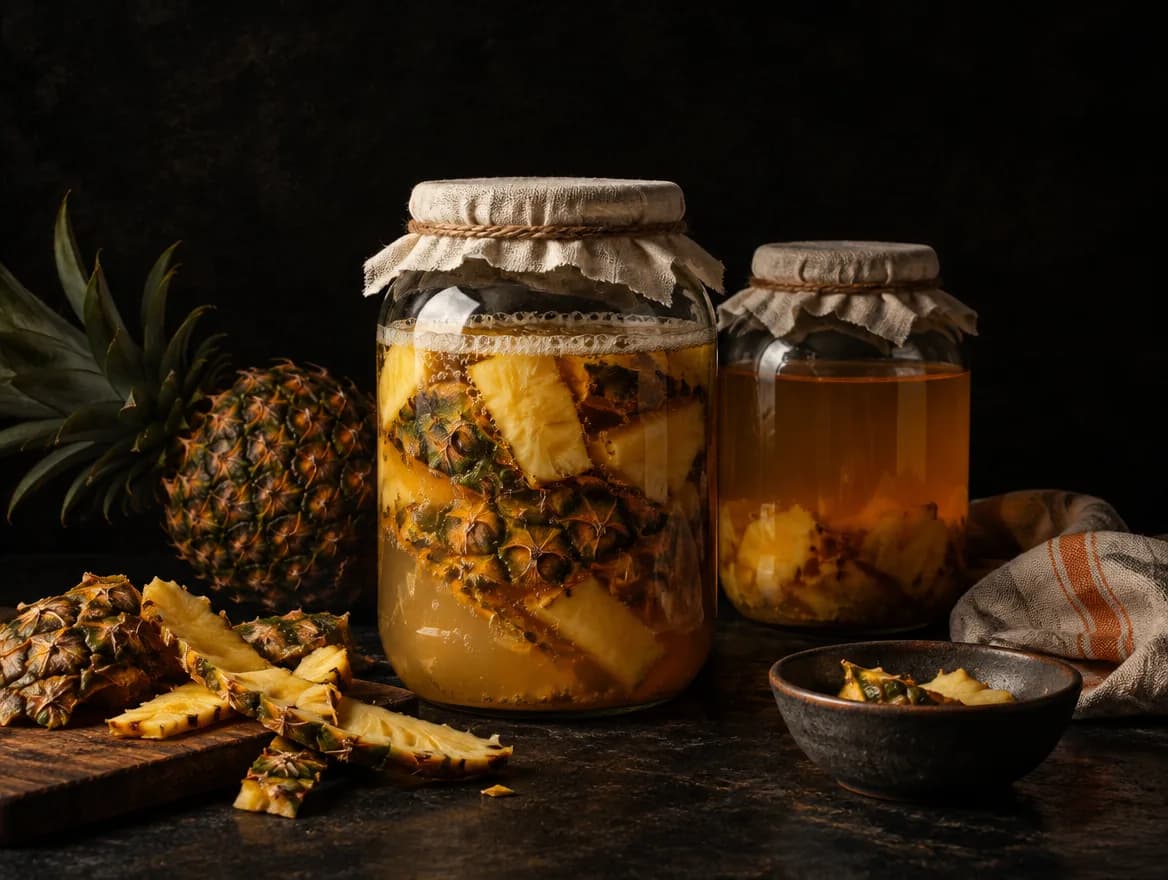
Heather fermented pineapple peel and core with maple syrup, cloves, and cinnamon, then explored maintaining it like her apple brine and allowing it to progress toward vinegar. This is a sugar-driven wild ferment rather than a salted vegetable brine, so it may pass through sweet, fizzy, alcoholic, and vinegar-like stages. For a drinkable tepache-style ferment, keep the fruit submerged during the short initial fermentation, monitor it closely, and refrigerate when its aroma and flavor are pleasantly fruity and tart. For vinegar development, strain out the fruit after the active alcoholic stage, transfer the liquid to a clean wide-mouthed vessel, and cover it with a tightly secured breathable cloth. Acetic-acid bacteria require oxygen to convert alcohol into acetic acid. Do not add salt when vinegar is the goal, because salt can inhibit or slow the organisms involved. A translucent gelatinous film may develop during vinegar conversion, but appearance alone does not establish acidity or safety. Because this batch’s acidity was never measured and a later batch developed an uncertain chemical odor, treat it as an experimental kitchen ferment rather than standardized vinegar. Do not use homemade pineapple vinegar for canning or shelf-stable preservation unless its acidity has been reliably established by an appropriate testing method.
Ingredients
Check off each item as you go.
Method
Prepare the pineapple
Wash the pineapple thoroughly under clean running water and scrub the exterior before removing the peel and core. Use clean equipment and discard damaged or visibly moldy fruit.
Start the ferment
Place the pineapple peel and core, maple syrup, cloves, and cinnamon in a clean vessel with enough dechlorinated water to cover. Keep the solids submerged during the initial active fermentation and protect the vessel from insects.
Monitor the tepache stage
Check the ferment frequently for bubbling and a clean fruity, yeasty, or tart aroma. Fermentation speed varies with temperature and ingredient ratios. Refrigerate and strain when it reaches the desired young, lightly fermented character.
Transition toward vinegar
If vinegar is the goal, allow an alcoholic stage to develop, then strain out the pineapple solids. Transfer the liquid to a clean vessel with a broad surface area and secure a breathable cloth over the opening so oxygen can reach the liquid while insects stay out.
Allow acetic fermentation
Leave the strained liquid at a moderate room temperature and observe it over several weeks. A translucent film may form. Do not assume that sour flavor, a film, or elapsed time proves a particular acidity.
Evaluate and store
Discard the batch if it develops fuzzy mold, putrid odors, or a persistent solvent-like or otherwise concerning chemical smell. If the finished liquid smells clean and vinegar-like, store it as an experimental culinary vinegar in the refrigerator; do not rely on it for canning.
Safety & handling
- Do not taste a ferment with fuzzy mold, putrid spoilage odors, or a persistent chemical or solvent-like smell; discard it.
- Wild pineapple fermentation can produce alcohol even when the intended product is a soft drink or vinegar.
- Do not tightly cap an actively fermenting liquid unless using equipment designed to manage pressure.
- Homemade vinegar of unknown acidity should not be used for canning or other shelf-stable preservation. pH alone does not establish the acetic-acid concentration required by a canning recipe.
- A surface film cannot by itself distinguish a successful vinegar from every form of contamination.
Insider tips
- A young pineapple ferment changes quickly; refrigeration slows further fermentation but does not sterilize it.
- Leave headspace and avoid tightly sealing an actively fermenting batch because carbon dioxide can create dangerous pressure.
- Salt is useful in some vegetable ferments but works against the desired yeast-to-acetic-acid progression here.
- A vinegar mother or surface film can indicate acetic fermentation, but it does not verify acidity.
- Refreshes change the sugar, alcohol, acidity, and microbial balance, so a perpetual jar is less predictable than a measured new batch.
Family notes
- Heather’s batch used maple syrup, cloves, cinnamon, and all of the pineapple peel and core.
- Heather wanted to maintain the pineapple ferment similarly to her apple brine and later preferred the idea of developing it into vinegar.
- The ferment later became vinegar-like, but its exact formula and acidity remained unresolved.
- A later chemical-smell concern made the condition of at least one batch uncertain.
Background & original notes
Heather fermented pineapple peel and core with maple syrup, cloves, and cinnamon, then explored maintaining it like her apple brine and allowing it to progress toward vinegar. This is a sugar-driven wild ferment rather than a salted vegetable brine, so it may pass through sweet, fizzy, alcoholic, and vinegar-like stages. For a drinkable tepache-style ferment, keep the fruit submerged during the short initial fermentation, monitor it closely, and refrigerate when its aroma and flavor are pleasantly fruity and tart. For vinegar development, strain out the fruit after the active alcoholic stage, transfer the liquid to a clean wide-mouthed vessel, and cover it with a tightly secured breathable cloth. Acetic-acid bacteria require oxygen to convert alcohol into acetic acid. Do not add salt when vinegar is the goal, because salt can inhibit or slow the organisms involved. A translucent gelatinous film may develop during vinegar conversion, but appearance alone does not establish acidity or safety. Because this batch’s acidity was never measured and a later batch developed an uncertain chemical odor, treat it as an experimental kitchen ferment rather than standardized vinegar. Do not use homemade pineapple vinegar for canning or shelf-stable preservation unless its acidity has been reliably established by an appropriate testing method.
Sources & what was completed
Record provenanceWilliams family historical source + clearly separated usability completion
Completed for usability- The family record did not preserve exact quantities, temperatures, acidity measurements, or a confirmed refresh schedule.
- The structured transition from submerged pineapple fermentation to strained, oxygen-exposed vinegar fermentation was completed for usability from general fermentation practice; it is not represented as a family-tested formula.
- Refrigerated storage and conservative discard guidance were added because the later chemical-smell uncertainty was not resolved.
Recorded by Williams family record + completion on Sep 26, 2026.