
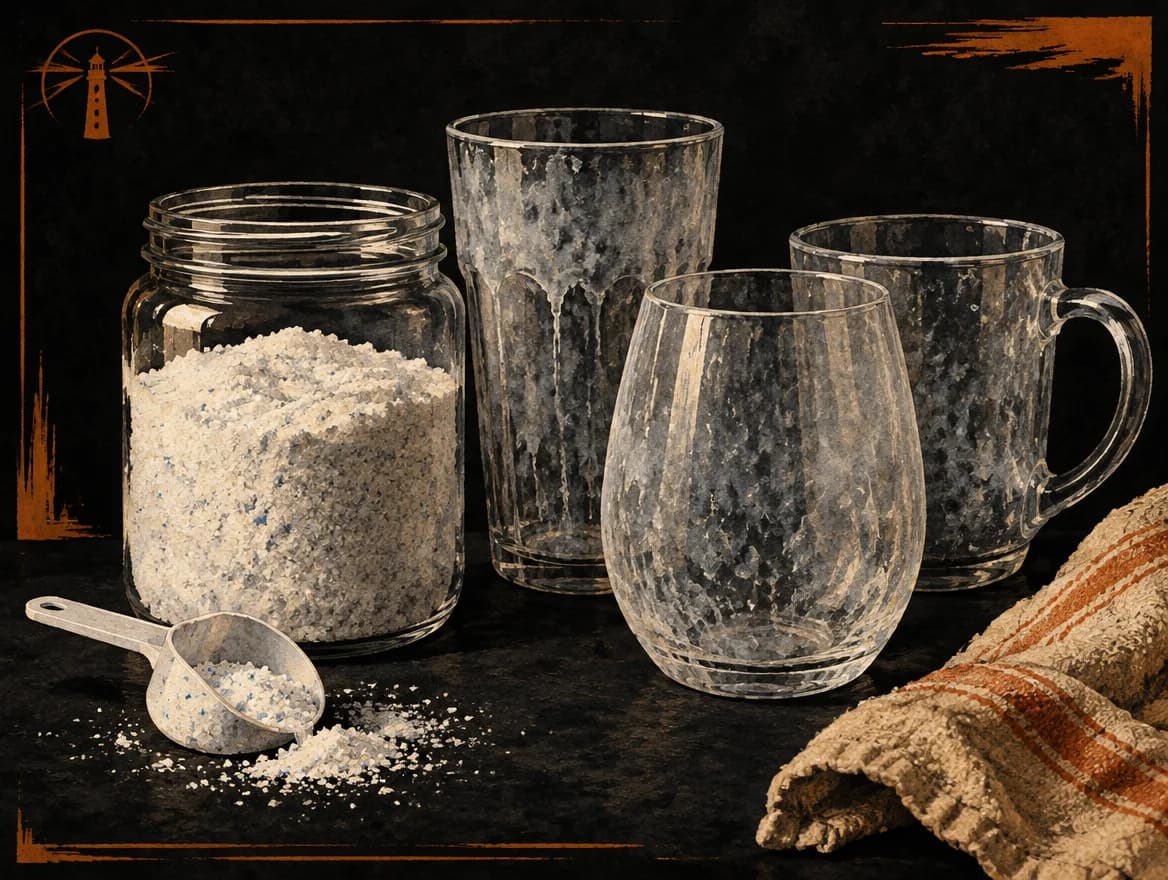
The March source preserves a complete written recipe, followed by Heather's report of spotless, sparkling dishes. The ingredients below are therefore recovered written quantities, not guessed proportions. However, later uncertainty about actual batches means the original success does not validate every subsequent mixture.
This remains a household experiment rather than an appliance-manufacturer-approved detergent. Follow the dishwasher and dishware manufacturers' requirements. Historical lemon juice in the rinse-aid compartment is an observation, not a practice recommended here.
Ingredients
Recorded dry ingredient volumes total 3 1/4 cups; actual packed yield and load count were not measuredCheck off each item as you go.
Recorded process
Historical steps only. Missing quantities must be resolved before this can be a repeatable formula.
Check compatibility first
Use only products and methods permitted by the dishwasher and dishware manufacturers. The following is the recovered household preparation, not manufacturer approval.
Use dry tools
The written preparation used a dry bowl, utensil and labeled storage jar. Avoid breathing powder and protect eyes and skin.
Recorded dry mixing
The five listed dry ingredients were combined gently. Keep moisture out; do not add water and then seal the mixture.
Recorded dose
The written dose was 1 to 2 tablespoons in the detergent compartment per load. Actual performance depends on the machine, water and batch; the source does not establish a universally effective dose.
Keep rinse aid separate
Use the machine's approved rinse aid. Do not put fresh lemon juice, this powder or a foaming soap into the rinse-aid reservoir.
Record a changed batch
Log every omission or substitution, dose, cycle and outcome. Do not attribute the white-film failure to one ingredient when the actual altered mixture was uncertain.
Safety & handling
- Keep the powder dry and labeled, away from children. Follow each ingredient's label precautions.
- Do not prepare a water-based oxygen-cleaner mixture for sealed storage.
- Do not treat household table salt in the detergent as a replacement for an appliance's dedicated softener system.
- Use manufacturer-approved rinse aid and follow appliance/material exclusions. A family success report is not a universal compatibility guarantee.
Troubleshooting
- White chalky film after washing may be mineral residue from hard water or an overly alkaline detergent. Reduce the detergent dose first and confirm that citric acid was not omitted.
- To test recent mineral film, soak one affected glass in warm citric-acid solution or vinegar. If the cloudiness clears, it was removable residue; haze that remains unchanged may be permanent etching.
- For a dishwasher-wide mineral cleanup, the family was previously advised to run affected glasses without detergent using 3–4 tablespoons of citric acid on the hottest suitable cycle. This recovery method was suggested but no family result was recorded.
- If the powder clumps, discard any damp or actively reacting portion and remake it with dry tools; consider storing the citric acid separately.
- If film continues after lowering the dose, test a revision without borax rather than changing several ingredients at once.
- If cleaning is weak but dishes rinse clear, increase from 1 tablespoon toward 2 tablespoons or dose dry sodium percarbonate separately.
Insider tips
- Test a small batch before producing a full jar because the exact successful family mixture is uncertain.
- Moisture can make citric acid and washing soda react and harden the blend. Separate storage and per-load dosing are more reliable in humid conditions.
- If storing sodium percarbonate separately, add it only when loading the dishwasher and keep its container tightly closed.
- Do not use fresh lemon juice in the rinse-aid reservoir; its pulp and sugars can foul the dispenser.
- Avoid using this alkaline detergent on aluminum, hand-painted dishes, delicate finishes, or other items excluded by the dishwasher or item manufacturer.
Family notes
- Heather reported that an early dry dishwasher mixture left the dishes spotless and sparkling.
- When citric acid and sodium percarbonate were unavailable, a temporary washing-soda/baking-soda/salt mixture was proposed.
- After returning home, Heather observed that dishes washed with the temporary or otherwise altered mixture were covered in white residue.
- Heather believed the failed batch omitted citric acid and sodium percarbonate, but she was unsure whether its other ingredients were baking soda, washing soda, borax, or some combination.
- No later family report confirms that the reconstructed formula or the proposed hard-water revision solved the problem.
Sources & what was completed
Record provenanceReviewed against original conversation text and attachments on September 27, 2026. Recorded family outcomes, original assistant proposals, and current editorial completion are distinguished below.
Completed for usability- The complete ingredient list is directly present in the original March conversation.
- The distinction between a written recipe and the contents of later actual batches remains important. No successful new reformulation is invented.
- Handling and appliance cautions are editorial corrections, not a claim that this exact revised procedure has been family-tested.
Recorded by Reviewed source recovery on Sep 27, 2026.