
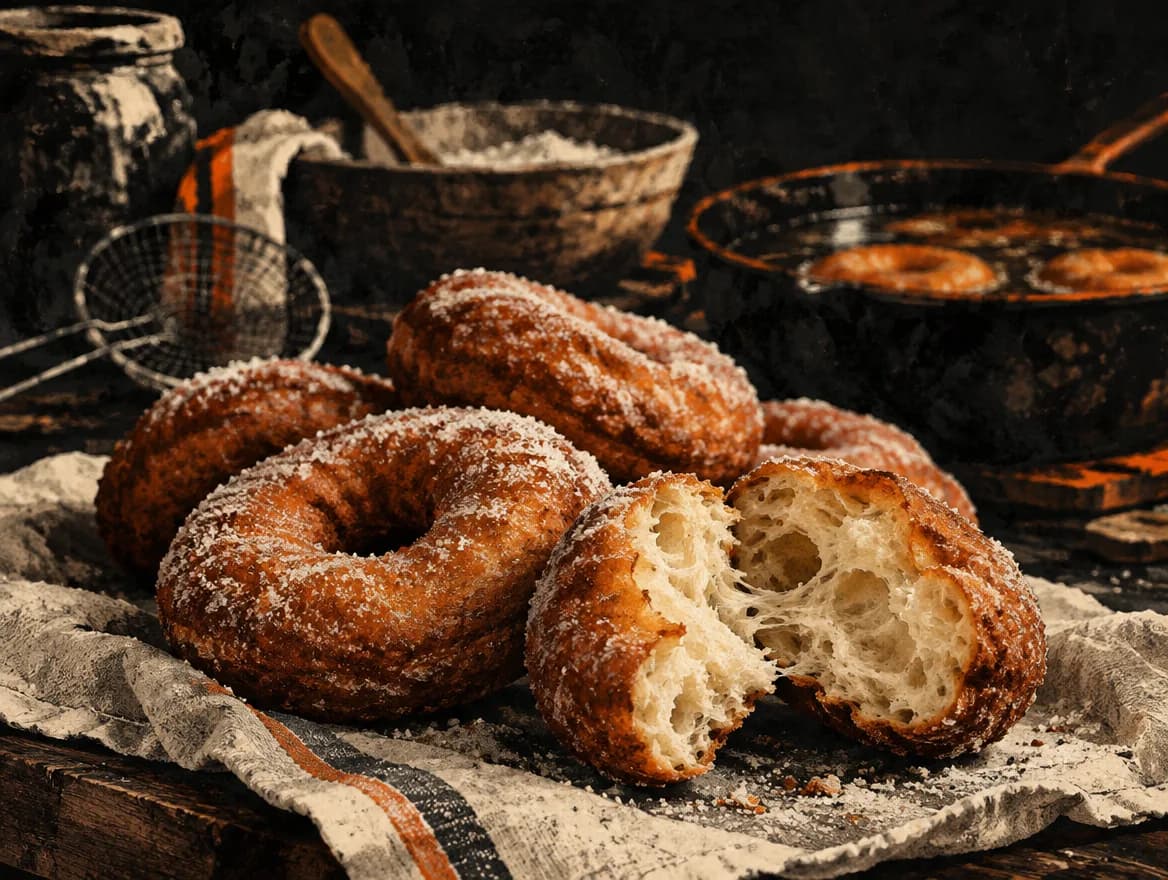
This reconstructed recipe preserves the defining features of Heather’s successful batch: a sweet stiff levain, tangzhong, two eggs, five tablespoons of butter, fresh nutmeg, volume measurements, an overnight cold rest, and hand mixing. The original dough was described as incredible and not sour, but the reconstructed quantities are not yet family-tested.
Ingredients
About 12 ring donuts plus holesCheck off each item as you go.
Method
Build the sweet stiff levain
Mix the stirred-down starter, 1/2 cup flour, 2 tablespoons milk, and 1 tablespoon sugar. Knead briefly into a stiff little ball, adding another spoonful of flour if it is sticky-soft. Cover and leave at a comfortably warm room temperature until expanded, aerated, and pleasantly sweet-smelling, about 4–8 hours depending on starter strength.
Cook the tangzhong
Whisk 3 tablespoons flour with 1/2 cup milk in a small saucepan. Cook over medium-low heat, stirring constantly, until it becomes a thick, smooth paste and the whisk leaves visible trails. Transfer to a bowl and cool to lukewarm.
Combine the dough
In a large bowl, combine 3 cups of the flour, the sugar, salt, and nutmeg. Add the ripe levain in small pieces, cooled tangzhong, eggs, milk, and vanilla. Mix by hand until no dry flour remains. Add enough of the reserved flour to create a very soft, cohesive dough; it may initially look ragged and sticky.
Work in the butter
Add the soft butter a tablespoon at a time, squeezing and folding until each addition is absorbed. Expect the dough to become messy and sticky before it strengthens. Do not flour away the moisture that will create the airy crumb.
Develop by hand
Slap and fold the dough for 10–15 minutes, using a bench scraper and slightly wet fingers. It should eventually become smoother, elastic, and able to stretch several inches before tearing. If it turns shiny, greasy, or smearing because the butter is warm, refrigerate it for 10 minutes and continue. Alternatively, cover and rest for 10 minutes, fold for 30 seconds, and repeat for three or four rounds.
Begin fermentation
Place the dough in a lightly greased bowl, cover, and let it begin to rise at room temperature until slightly expanded and aerated rather than fully doubled, approximately 1–3 hours depending on dough and room temperature.
Chill overnight
Cover securely and refrigerate overnight, about 8–14 hours. The cold rest firms the butter and continues developing the dough, making the soft dough easier to roll and cut.
Cut the donuts
Roll the cold dough on a lightly floured surface to about 1/2 inch thick. Cut rings cleanly without twisting the cutter. Place each ring and hole on its own small parchment square so it can later be moved without deflating.
Final proof
Loosely cover the pieces so their surfaces do not dry. At 72°F, allow roughly 2 1/2–4 hours; a 78–80°F environment will be faster. The donuts are ready when the sharp cut edges have rounded, the rings are about half again their original volume, the holes have tightened, and the dough wobbles gently. Test with a floured fingertip pressed only 1/4 inch into the fattest part: the impression should refill slowly. A deeper poke can crush the cells and is not a useful reading.
Prepare the glaze
Whisk the powdered sugar, milk or cream, vanilla, and salt until completely smooth and thick enough to fall in a ribbon that disappears after a couple of seconds. Adjust with drops of liquid or spoonfuls of powdered sugar. Press wrap directly against the surface while it waits.
Heat the frying fat
Melt equal weights of tallow and refined coconut oil in a deep, heavy pot, maintaining adequate headroom. Heat to 350°F. Send one donut hole in first as a scout: it should swell, ride high, and cook through with an airy interior. If it remains low and dense, give the shaped donuts another 20–30 minutes before retesting.
Fry
Handle proofed donuts gently, lifting them by their parchment squares and peeling the paper away as they enter the fat. Fry only two or three at a time for about 90 seconds per side, until deeply golden and cooked through. Maintain approximately 350°F and allow the fat to recover between batches. Drain on a rack.
Glaze while warm
Let each donut cool for a minute or two, then dip its top into the glaze with a small twist. Return it to the rack and allow the glaze to set for about 10 minutes. If the glaze stiffens, loosen it with a teaspoon of hot water.
Safety & handling
- Use a deep, heavy pot with substantial empty space above the fat. Keep children, water, loose clothing, and combustible items away from the frying station, and never leave hot fat unattended.
- Use a reliable thermometer and control the heat carefully. Overheated fat can smoke or ignite; never extinguish a grease fire with water.
- If using raw milk or cream in uncooked glaze, people at higher risk of foodborne illness should use pasteurized dairy instead.
- Fermentation time alone does not establish safety. Use clean equipment, sound ingredients, a healthy starter, and discard dough showing mold, colored growth, or a putrid odor.
Insider tips
- Fresh nutmeg supplies the familiar old-fashioned donut-shop aroma without making the dough taste strongly spiced.
- The correct hand-mixed texture is soft and slightly tacky—described in the family conversation as ‘an earlobe with ambition.’ Correct an overly firm dough with a splash of milk; correct a truly wet dough with flour one spoonful at a time.
- Parchment squares protect the gas retained during the final proof and make delicate donuts easier to transfer to the fryer.
- Cold butter makes shaped dough feel heavier than ordinary yeasted dough. Much of the final lightness develops during the warm proof and frying.
- Do not wait for a visual doubling. Ring donuts expand upward and inward, so rounded shoulders, a gentle wobble, and the shallow-poke response are better indicators.
- For a brown-butter glaze variation, brown 2 tablespoons cultured or unsalted butter until nutty, cool slightly, and whisk it into the glaze; add powdered sugar as needed to restore dipping consistency.
- A future potato variation may incorporate 1/4 cup plain mashed russet potato and reduce the dough milk by about 1 tablespoon, but this was suggested rather than family-tested.
- The proposed hand-stretched Yoder-style version used a leaner, slacker potato dough and remains untested; preserve it as a separate future experiment rather than silently substituting it for this donut.
Family notes
- Heather prefers cups and spoons rather than weighing ingredients.
- Heather mixed the successful batch entirely by hand.
- Heather described the original dough as incredible and specifically noted that it was not sour.
- The successful fry used tallow with refined coconut oil for a clean, sweet-tasting finish.
- The shaped dough initially felt heavier than expected, but it later showed rounded shoulders and a pillowy, properly proofed appearance.
- Heather has extensive commercial mini-donut experience and was specifically seeking the sweetness once associated with commercial shortening, using more traditional fats instead.
Background & original notes
This reconstructed recipe preserves the defining features of Heather’s successful batch: a sweet stiff levain, tangzhong, two eggs, five tablespoons of butter, fresh nutmeg, volume measurements, an overnight cold rest, and hand mixing. The original dough was described as incredible and not sour, but the reconstructed quantities are not yet family-tested.
Suggested schedule: build the levain in the morning, mix the dough that evening, refrigerate overnight, then cut, proof, and fry the following morning. Keep the fermentation moving rather than extending it unnecessarily; the sweet stiff levain and cold rest are intended to produce mild flavor, not pronounced sourness.
Measure flour by spooning it into the cup and leveling it. The dough should remain very soft and slightly tacky after the butter is incorporated. Use wet fingertips and a bench scraper instead of adding substantial flour. At a 72°F room temperature, cold cut donuts may need 2½–4 hours for their final proof. Judge readiness by rounded shoulders, visible inflation, a gentle wobble, and a shallow ¼-inch floured fingertip impression that returns slowly. They do not need to look doubled.
The hand-stretched, Yoder-style market donut discussed in the family source was a proposed future variation, not a tested result, and is therefore not presented here as the canonical formula.
Sources & what was completed
Record provenanceWilliams family historical source + clearly separated usability completion
Completed for usability- The original complete dough formula was lost; the dough quantities and several routine timing details here are a usability reconstruction from surviving ingredient, process, and sensory clues.
- The documented family-tested history applies to the original hand-mixed batch and its outcome, not yet to these reconstructed measurements.
- The glaze proportions, hand-mixing guidance, proof cues, 350°F frying temperature, and tallow–refined coconut oil preference are preserved directly from the family conversation.
- The untested Yoder-style hand-stretched formula is intentionally excluded from the canonical method.
Recorded by Williams family record + completion on Sep 26, 2026.