
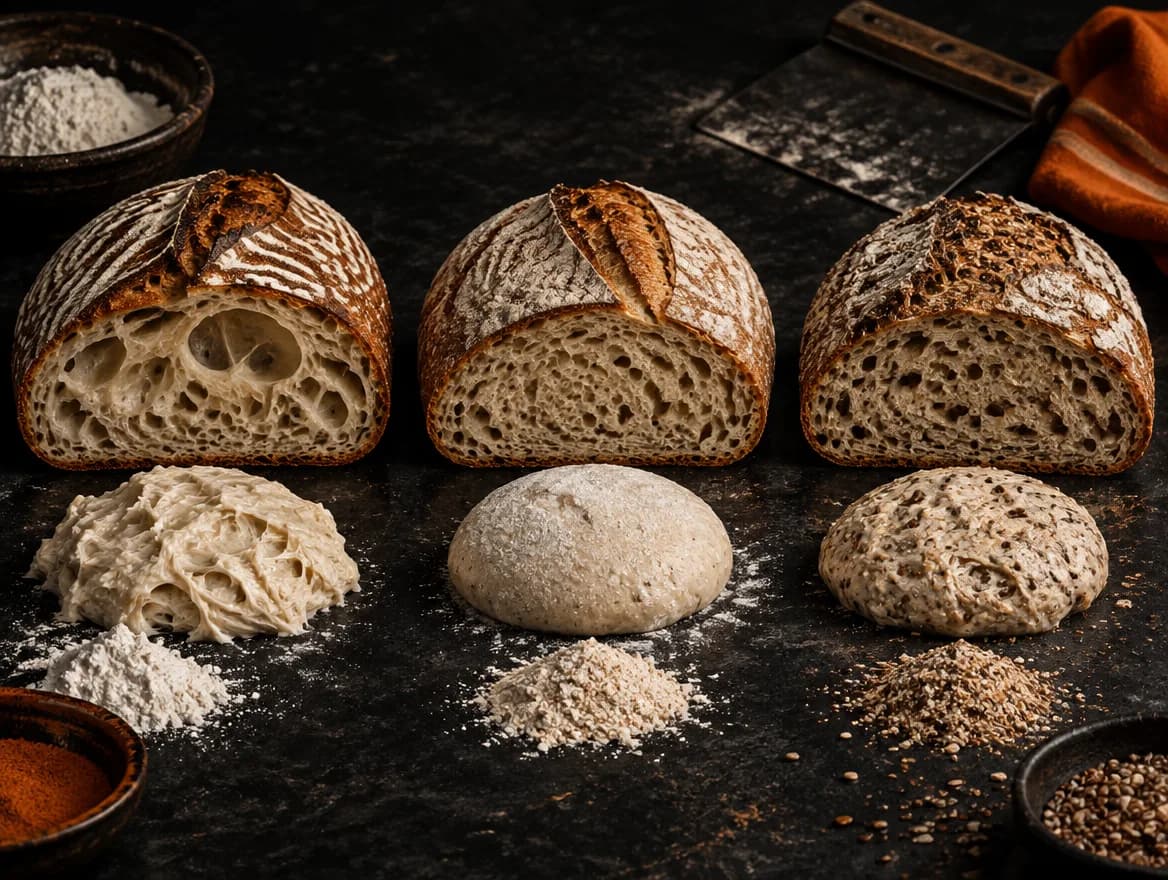
Heather experimented with changing the flour and sweetener used in established sourdough baking. Montana white wheat flour was the familiar baseline. Whole red wheat and einkorn were considered as more flavorful whole-grain options, with apple fermentation brine also part of Heather’s broader sourdough practice.
Ingredients & materials
Check off each item as you go.
Recorded process
Historical steps only. Missing quantities must be resolved before this can be a repeatable formula.
New-flour blend trial
A new flour blend was tested against the established Montana-white-flour sourdough. The precise blend, hydration and fermentation schedule were not retained in this record.
Maple-sugar trial
An accidental maple-sugar batch was baked and evaluated for texture; the quantity and substitution it represented were not recorded.
Later recipe conversion
A converted sourdough formula was baked and evaluated. Its flavor was successful, but the salt level was too low.
Safety & handling
- Fermentation activity, sourness and aroma do not by themselves establish that a dough or fruit brine is safe. Use clean equipment and sound ingredients, and discard batches showing mold, putrid odors or other clear spoilage.
- No validated method for maintaining the salted apple brine indefinitely as a mother culture is established by this record.
Insider tips
- For an easier whole-grain transition, begin with hard red whole wheat blended with the familiar Montana white flour; this should behave more predictably than a high-einkorn dough.
- Einkorn has comparatively fragile gluten. Prior guidance suggested starting around 20–30% einkorn for laminated doughs and testing higher proportions first in breads, rolls, pita or naan.
- When changing flour, record the flour percentages, total hydration, fermentation time and dough temperature; otherwise increased sourness or a softer crumb cannot be traced reliably.
- Change one major variable at a time and keep an established loaf as the baseline.
- Increase salt cautiously in the under-salted conversion only after recovering the original dough weight and salt amount.
Family notes
- The new-flour blend became more sour than the established version.
- The new-flour loaf did not cut as cleanly.
- The accidental maple-sugar batch was notably soft.
- The later conversion was flavorful but under-salted.
- Heather uses fresh apple brine in sourdough because it creates a very soft dough.
Background & original notes
Heather experimented with changing the flour and sweetener used in established sourdough baking. Montana white wheat flour was the familiar baseline. Whole red wheat and einkorn were considered as more flavorful whole-grain options, with apple fermentation brine also part of Heather’s broader sourdough practice.
The new-flour blend produced a noticeably more sour loaf with a less clean-cutting crumb than the established version. A separate batch made accidentally with maple sugar was notably soft. A later recipe conversion had good flavor but needed more salt.
These observations should remain separate rather than being merged into one recipe. Exact flour ratios, dough hydration, maple-sugar quantity, salt quantity, fermentation schedule and bake settings were not preserved here, so further batches should be treated as controlled trials rather than assumed reproductions.
Sources & what was completed
Record provenanceWilliams family historical source + clearly separated usability completion
Completed for usability- No canonical formula was reconstructed because the source does not preserve the measured flour ratios, hydration, salt level, fermentation schedule or baking instructions.
- The testing framework and flour-handling tips are editorial guidance, not Williams-family-tested outcomes.
- The three recorded outcomes are intentionally kept separate and should not be interpreted as results from one batch.
Recorded by Williams family record + completion on Sep 26, 2026.