
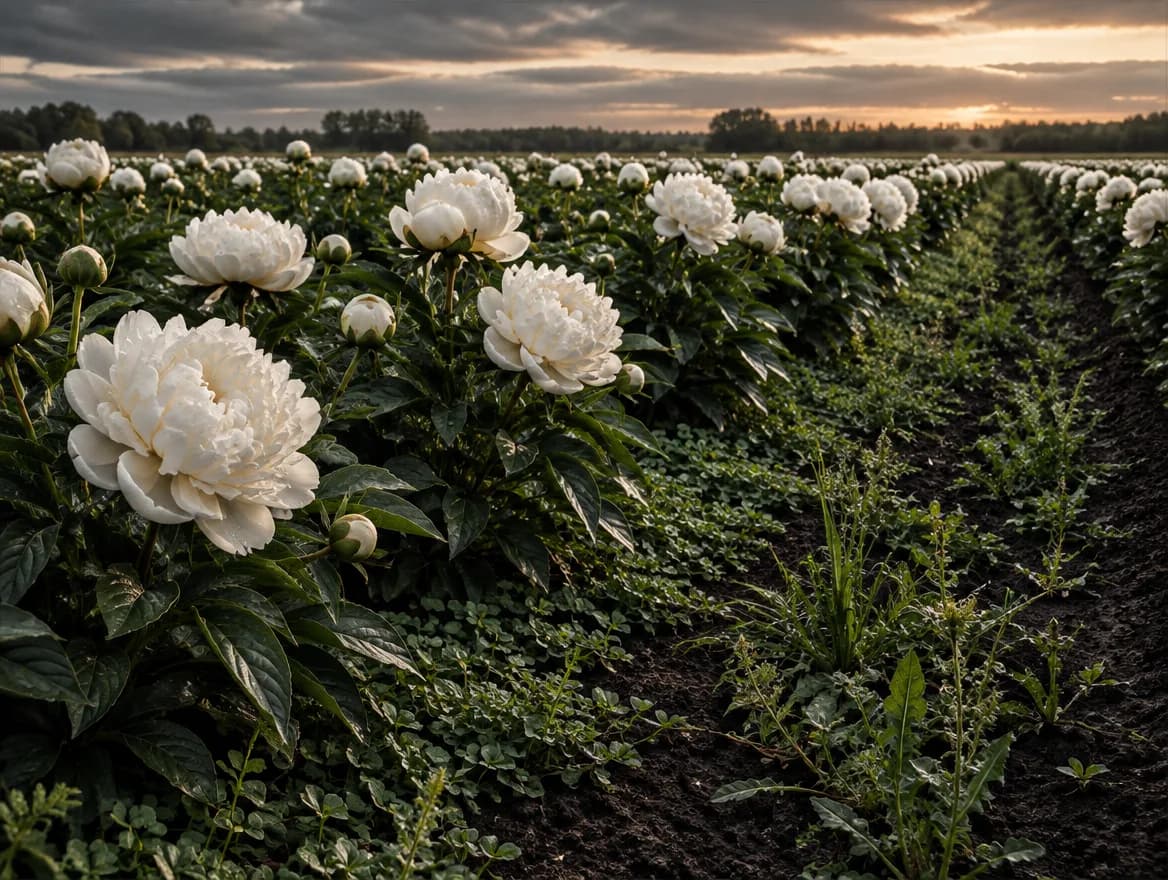
A living record for the peony field rather than a stack of disconnected historical notes.
Latest recorded state
- About 700 white peony plants total.
- Roughly 100 older plants are Festiva Maxima; in 2026 they were in year 4.
- Roughly 600 newer plants were in year 2 in 2026 and include several white cultivars plus a mixed-white planting.
- The older 100-plant section was managed organically without industrial plastic; the newer 600-plant section used industrial plastic and had persistent weeds.
- Spring 2026 late frost caused severe bloom loss, including about 95% flower loss in the older organic section and essentially complete bloom loss across the field according to later family reporting.
- Fall 2026 plan: test leaving the entire herbaceous field standing through winter instead of the usual cutback, after two uncut rows appeared less affected by spring frost. This is an experiment, not proof of causation.
Varieties in the field
Festiva Maxima
about 100 confirmed in the older section, plus additional plants may exist in the newer mixAll 100 older plants are Festiva Maxima.
Charlie White
quantity not recoveredPresent in the newer white planting.
Shirley Temple
quantity not recoveredPresent in the newer white planting; Heather noted very red spring growth and white prior-year blooms.
Duchesse de Nemours
quantity not recoveredPresent in the newer white planting.
Bowl of Cream
quantity not recoveredPresent in the newer white planting.
Auten's White
part of mixed-white order; exact quantity not recoveredMixed-white planting.
Dr. F.G. Brethour
part of mixed-white order; exact quantity not recoveredMixed-white planting.
Henry Sass
part of mixed-white order; exact quantity not recoveredMixed-white planting.
Krinkled White
small replacement order; exact quantity not recoveredUsed to replace a few plants that did not come up well.
Watering setup
- Year 1 and again the following year: drip irrigation on the older 100+ plants. Heather found emitter placement difficult and many areas stayed dry.
- After the field expanded by about 600 plants: overhead watering was tried. Dry spots remained and outer-edge plants did not receive enough water.
- Current reported 2026 practice: hand-water for about two hours, twice a week.
- A row-by-row soaker-hose system was under consideration for the whole field; no final diameter/material or installed result was confirmed.
- The back row historically received less water; roughly 25 plants may have been lost amid dry conditions and shifted plastic.
What we learned
- The original drip layout did not adequately water the field.
- Overhead irrigation also left dry zones and weak outer-edge coverage.
- Hand-watering is currently the most dependable known practice, although it is labor intensive.
- The two rows left uncut through winter appeared to emerge strongly and later seemed less affected by the 2026 spring frost, but variety and other confounders mean this is not proof that no-cutback caused the difference.
- The field is all white peonies even though spring stem/body color differs markedly between cultivars.
- Late frost is currently the most consequential documented production loss.
Organic inputs
- Duck-coop deep-litter material: straw/pine bedding with manure, containing both older and newer layers.
- Organic bone meal.
- Micronized azomite.
- Mycorrhizal fungi.
- Kelp meal was selected as the next preferred addition because the family wanted an organic potassium-oriented supplement.
Ground cover & weeds
- Buckwheat was chosen as the earlier temporary cover around the peonies.
- Red creeping fescue was planned for fall as the longer-term cover around the field.
- Heather discussed cutting buckwheat before seed set; later results were not confirmed in the source history.
Experiments
No-cutback winter test
expanding in fall 2026Two earlier uncut rows looked promising; entire-field no-cutback planned as an experiment.
Cold storage at marshmallow stage
failed/uncertainHeather later questioned whether buds had been harvested at the correct stage and planned to retry with revised understanding.
Buckwheat to red creeping fescue cover
planned/in progressBuckwheat as temporary cover, fescue planned for fall; completed field result not yet established.
Next steps & open questions
- Recover or create an exact cultivar map and count for the newer 600-plant section.
- Record whether the soaker-hose concept was installed and, if so, its actual layout and performance.
- Track the whole-field no-cutback experiment through spring 2027: frost exposure, disease pressure, emergence, bloom count and stem quality.
- Capture the exact amendment quantities actually applied rather than relying on planning estimates.
Sources & what was completed
Record provenanceWilliams family historical source
- Primary family history includes March–May 2026 raw Heather conversations plus reconciled Ninzu field episodes and K3's September 2026 clarification that current-facing peony imagery must show white peonies only.
Recorded by Williams family record on Sep 26, 2026.