
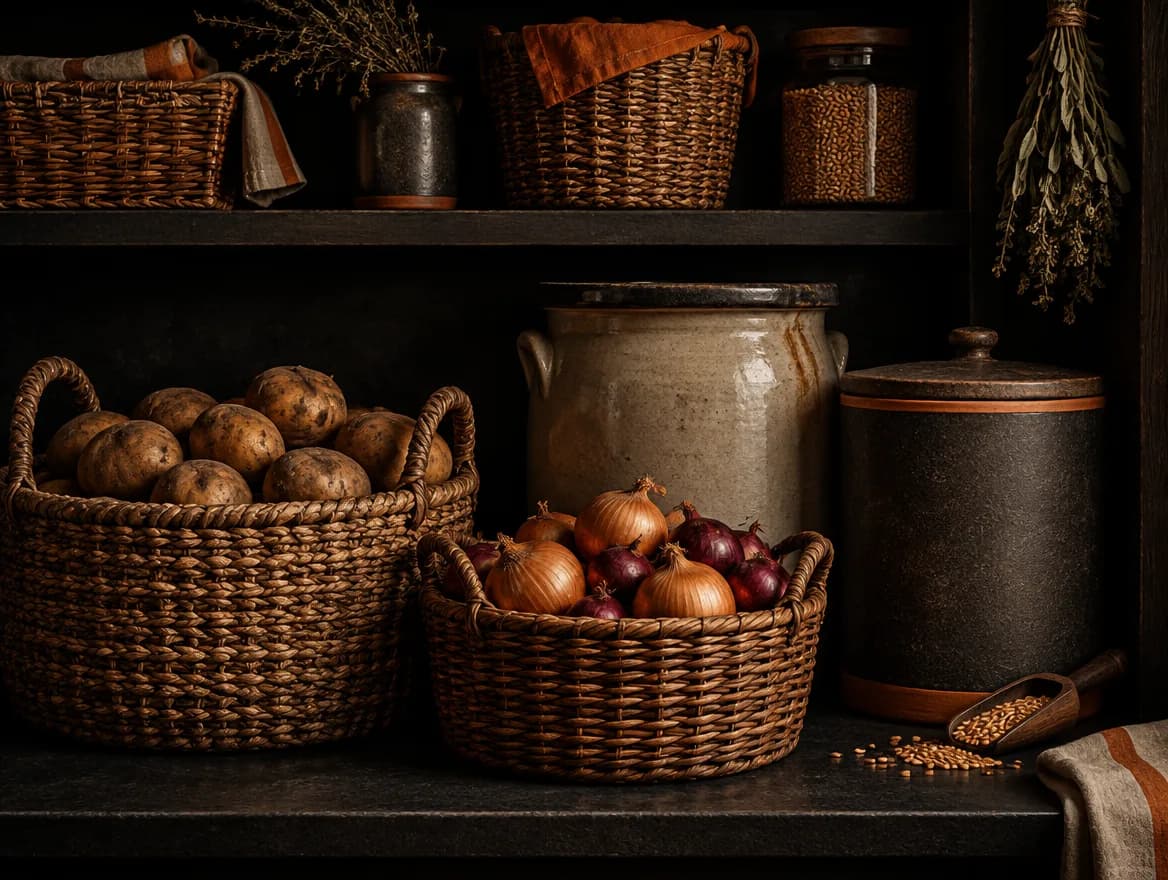
## Potatoes Use a rigid, open-weave peeled-willow basket. Keep it dark with a loose, breathable burlap or linen cover, and place it in the coolest suitable pantry area. Do not wash potatoes before storage. Inspect regularly and remove any green, sprouting, soft, or moldy potatoes.
Ingredients & materials
Check off each item as you go.
Method
Cure and sort the crops
Store only sound, dry potatoes and fully cured onions. Do not wash potatoes before storage. Remove damaged produce and continue checking the baskets regularly.
Prepare the potato basket
Place potatoes in an open-weave willow basket, cover loosely with breathable burlap or linen to exclude light, and keep the basket cool and away from freezing temperatures.
Prepare the onion basket
Place cured onions in an unlined, uncovered willow basket. Raise the basket above a solid shelf to improve airflow.
Separate the crops
Keep the potato and onion baskets on separate shelves or several feet apart rather than combining them.
Limit the working flour supply
Put only approximately four to six weeks of whole-grain flour in the pantry crock or jar. Keep the remaining flour colder for longer storage.
Protect flour from insects
Claude advised freezing each incoming bag for 72 hours. Keep it sealed while warming back to room temperature before transferring or opening.
Seal flour against humidity and odors
Place flour in an airtight, food-grade barrier before putting it in a crock or humid cheese refrigerator. Do not rely on a retail flour bag or loose crock lid.
Prevent condensation
When removing flour from cold storage, allow the sealed container to reach room temperature before opening it.
Troubleshooting
- Potatoes turning green: improve the breathable light cover and remove green potatoes from food use.
- Onions becoming damp or moldy: remove the liner or cover, increase airflow beneath the basket, and verify that the onions were fully cured.
- Basket developing mold: move the produce to a dry clean container, discard spoiled items, and replace moisture-holding fiber baskets with rigid open-weave wood.
- Flour developing a damp crust or clumps: condensation or humidity has entered; discard flour showing mold or abnormal odor and correct the seal before restocking.
- Flour absorbing cheese odors: use a gasketed vapor-resistant container rather than the original bag.
- Flour tasting bitter, stale, waxy, or paint-like: treat it as rancid and discard it; bay leaves cannot correct rancidity.
Insider tips
- Willow can be identified by its individual woody rods and visible bud scars; water hyacinth usually resembles soft, twisted rope.
- Avoid water-hyacinth, seagrass, banana-leaf, plastic-lined, glued, or varnished baskets in damp potato storage; Claude considered them more prone to retaining moisture or molding.
- Light promotes potato greening, so darkness matters as much as basket material.
- Do not refrigerate potatoes at ordinary refrigerator temperatures; very cold storage can increase sugar formation and affect flavor and browning during cooking.
- Whole-grain flour can develop crayon-like or oil-paint odors as its fats become rancid; discard it if its smell or flavor is stale or abnormal.
- Bay leaves do not stop oxidation and are not a substitute for sealed or cold storage.
Family notes
- Heather wanted natural baskets for potatoes and onions in the new pantry.
- Heather specifically asked whether water hyacinth was willow; they are different materials.
- Heather considered keeping a red-wheat and Montana-wheat flour blend in a humid cheese refrigerator.
- Heather preferred high-quality, long-lived glass storage and considered imported European jars.
- No final basket, crock liner, glass brand, pantry temperature, or flour-storage arrangement was confirmed.
Background & original notes
## Potatoes Use a rigid, open-weave peeled-willow basket. Keep it dark with a loose, breathable burlap or linen cover, and place it in the coolest suitable pantry area. Do not wash potatoes before storage. Inspect regularly and remove any green, sprouting, soft, or moldy potatoes.
## Onions Store fully cured onions in their own bare, open-weave willow basket. Do not line or cover the basket. Raise it on a slatted shelf or narrow wooden strips so air can circulate underneath.
## Separation Do not combine potatoes and onions in one basket. Place them on separate shelves or several feet apart when the pantry allows.
## Whole-grain flour A six-gallon stoneware crock can serve as opaque, pest-resistant outer protection, but a loose crock lid is not an adequate humidity or insect barrier. Keep flour inside a sealed food-grade liner, gasketed bucket, or tightly sealed glass container.
Whole-grain red and white wheat flours contain germ oils and deteriorate faster than white flour. Keep only a four-to-six-week working quantity at room temperature. Store the balance in a freezer or in a cool refrigerator only when it is enclosed in a genuinely airtight, moisture-resistant container.
A humid cheese refrigerator is unsuitable for flour in its original retail bag. If used, put the entire flour bag inside a gasketed food-grade bucket or sealed jar to protect it from moisture, cheese odors, and environmental cultures. Let any cold container reach room temperature while still sealed before opening, preventing condensation on the flour.
## Pest precautions Claude advised freezing newly purchased flour for 72 hours before pantry storage as an insect-control step. A bay leaf may mildly repel insects near the surface but should not be treated as protection against infestation or rancidity.
## Optional glass alternative For dry storage, a substantial jar with a sound, replaceable gasket can be used instead of a lined crock. Heather considered Bormioli Rocco Fido, Le Parfait, and Weck-style containers; no particular brand was purchased or family-tested in this history.
Sources & what was completed
Record provenanceWilliams family historical source + clearly separated usability completion
Completed for usability- This guide organizes Heather's questions and Claude's proposed methods into an operational plan.
- The separation, environmental targets, material recommendations, freezing interval, working-flour quantity, and cold-storage procedure came from Claude's technical guidance and were not reported as family-tested.
- Routine inspection, removal of spoiled produce, and explicit discard guidance were added to make the guide usable and safer.
- No storage-life guarantee is given because the pantry temperature, humidity, crop condition, container seal, and final family setup were not documented.
Recorded by Williams family record + completion on Sep 26, 2026.