
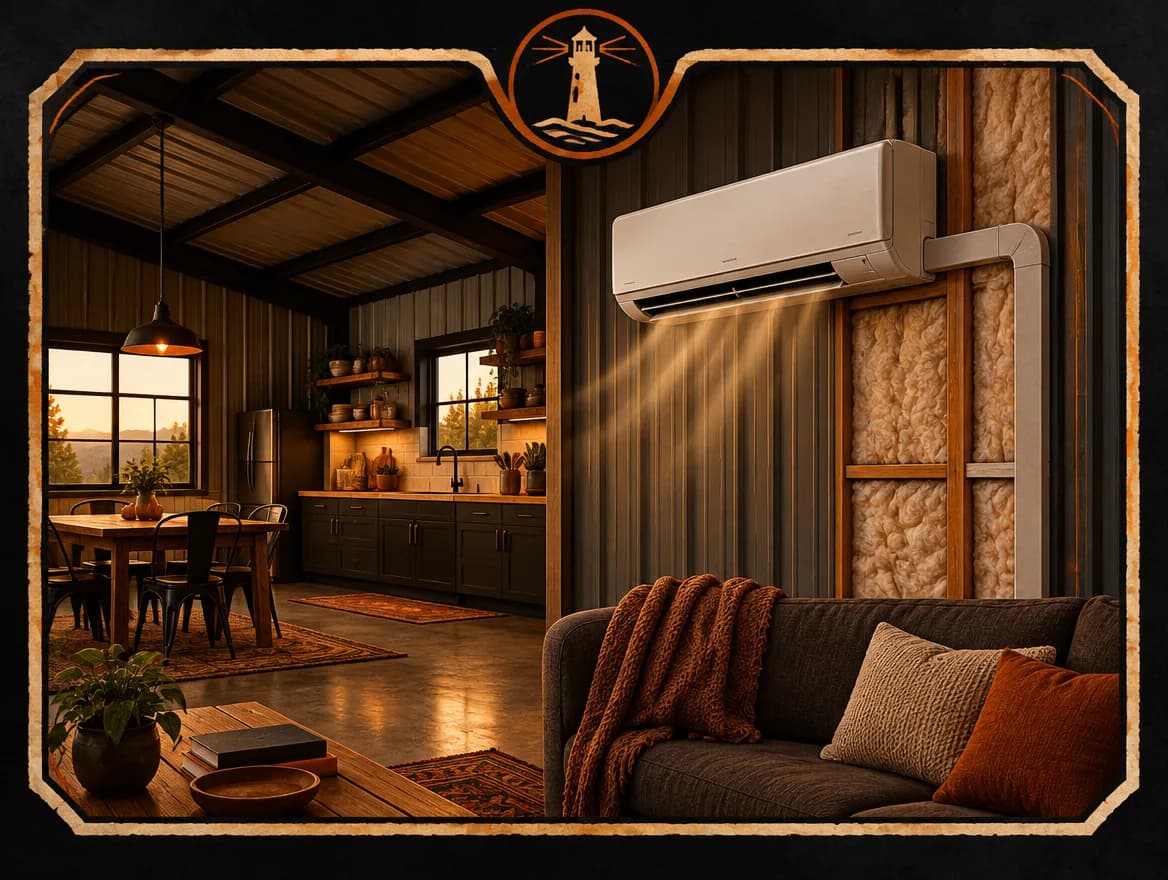
## What is known The home is a converted metal warehouse with insulated metal walls and roof. Solar exposure can heat the building shell, but actual cooling behavior depends on insulation, air sealing, window exposure, indoor thermal mass, mini-split sizing and weather.
Method
Choose the occupied setting
Use the normal comfortable cooling setpoint while the home is occupied.
Apply an away setback
For an absence of about five hours, begin by raising the cooling setpoint approximately 4–8°F. Turn cooling fully off only if heat, humidity and recovery time are acceptable.
Return to the normal setting
Restore the occupied setpoint before or when returning. Do not lower it beyond the desired temperature in an attempt to accelerate cooling.
Ventilate conditionally
Open doors briefly only when outside air is cooler and suitably clean and dry; otherwise keep the building closed.
Measure comparable days
Compare maintenance and setback strategies during similar weather, recording indoor temperature, comfort, recovery time and actual electricity use when possible.
Troubleshooting
- If recovery takes many hours, use a smaller setback, begin recovery earlier, check filters and airflow, and consider whether the unit is undersized or the building has major heat-gain or air-leakage problems.
- If the building becomes dangerously hot or humidity rises excessively while cooling is off, retain a protective away setpoint instead of shutting the system down.
- If opening the garage or building doors makes the interior warmer, smoky, dusty or more humid, close them and use mechanical cooling.
- If energy use remains unexpectedly high, inspect air sealing, insulation continuity, window solar gain and mini-split maintenance before assuming the thermostat strategy is the sole cause.
Insider tips
- Clean the mini-split filters and keep indoor and outdoor airflow unobstructed.
- Use blinds or exterior shading to reduce solar gain through windows.
- A plug-in or circuit energy monitor provides better evidence than judging from how long the unit runs.
- Long, low-power operation is normal for an inverter mini-split and does not by itself mean excessive energy use.
- Avoid frequent manual on-off cycling; use the thermostat or scheduling controls.
Family notes
- The family lives in a converted metal warehouse with insulated metal walls and roof.
- Heather and Kriss discussed whether to maintain approximately 70°F or turn cooling off during an approximately five-hour trip to Montana.
- Kriss expected that maintaining temperature might be more efficient than allowing the building to heat substantially before cooling it.
- The family considered opening the garage doors upon returning if outdoor conditions were cooler.
- The conversation ended without a family-tested operating rule or measured energy comparison.
Background & original notes
## What is known The home is a converted metal warehouse with insulated metal walls and roof. Solar exposure can heat the building shell, but actual cooling behavior depends on insulation, air sealing, window exposure, indoor thermal mass, mini-split sizing and weather.
## Practical operating rule When home, choose a comfortable setpoint and let the inverter mini-split modulate normally. For an absence of several hours, raising the setpoint usually saves energy because the smaller indoor-outdoor temperature difference reduces heat gain. Turning cooling completely off may save more energy, but can produce a long, uncomfortable recovery and may be inappropriate when heat or humidity could affect people, animals, food, medicines or belongings.
A useful starting point for a roughly five-hour summer absence is a moderate setback—about 4–8°F above the occupied setting—rather than assuming the unit must either maintain 70°F or remain completely off. Restore the occupied setting before or upon returning. Avoid setting the thermostat unusually low to speed recovery; it generally does not cool the space faster.
## How to establish the household rule Compare similar hot days using the same occupied setpoint. On one day, maintain that temperature while away. On another, use a moderate setback. Record outdoor temperature, departure and return times, indoor temperature on return, recovery time and mini-split electricity use if available. Comfort and measured energy use should determine the final rule.
## Ventilation on return Opening garage or building doors can help only when outdoor air is cooler and suitably dry. If the outdoor air is hotter, smoky, dusty or humid, keep the building closed and let the mini-split recover.
## Important correction to the earlier discussion The conversation claimed that maintaining a fixed temperature necessarily uses less total energy than allowing the building to warm and then cooling it again. That was not established and is generally not a safe assumption. In most cases, a cooling setback reduces total heat gain during the absence. An inverter mini-split may recover efficiently at higher output, and its startup does not ordinarily erase the energy saved by a reasonable setback.
Sources & what was completed
Record provenanceWilliams family historical source + clearly separated usability completion
Completed for usability- Added a moderate-setback option to make the guide operational; this was not reported as family-tested.
- Corrected the earlier unsupported claim that steady temperature maintenance necessarily consumes less energy than setback and recovery.
- Added conditional safety, humidity, ventilation and measurement guidance from general HVAC practice.
- No percentage savings or cost estimate is stated because the source contains no equipment capacity, electricity rate, measured consumption, indoor heat-gain data or controlled comparison.
Recorded by Williams family record + completion on Sep 26, 2026.