
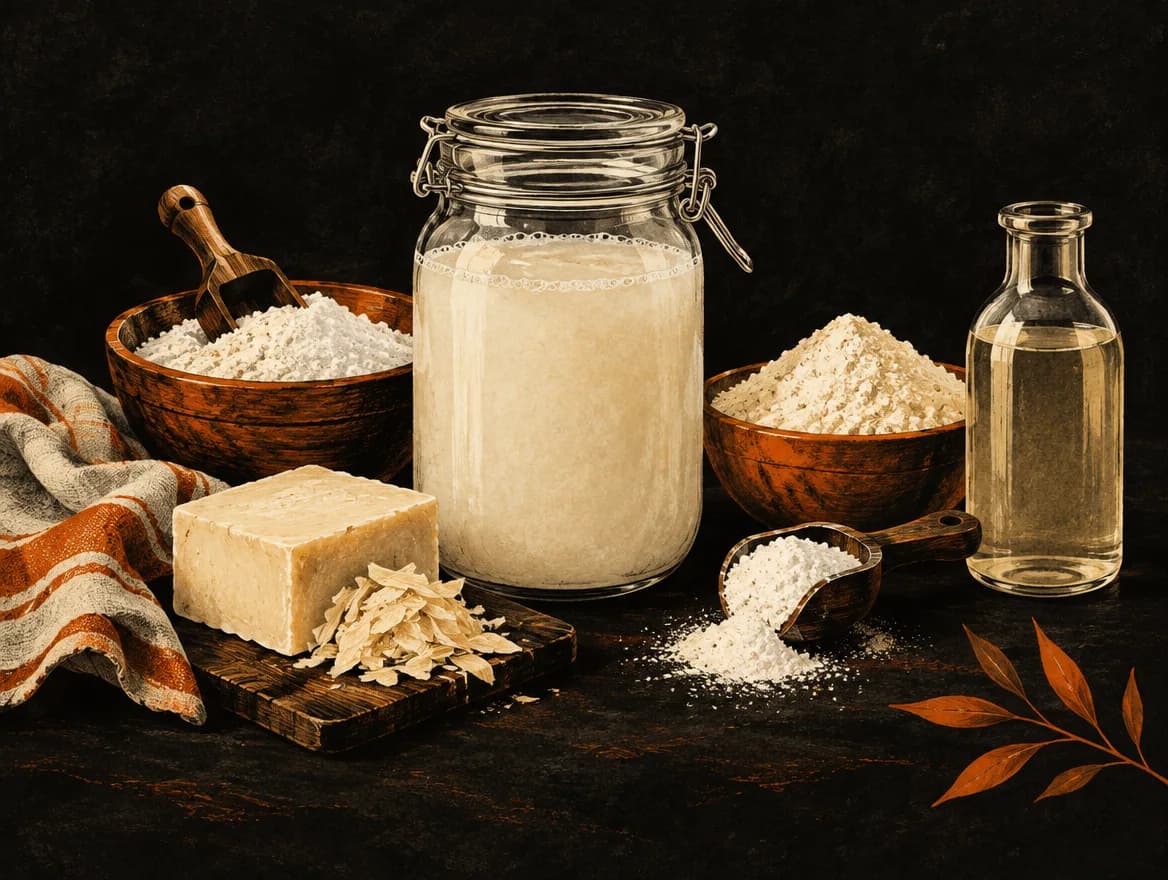
Status
Partial family formula requiring revision. Do not treat the reconstructed method or technical suggestions as family-tested proportions.
Ingredients
Not preserved; original family batch size and preferred proportions are missingCheck off each item as you go.
Recorded process
Historical steps only. Missing quantities must be resolved before this can be a repeatable formula.
Dissolve the mineral ingredients
Completion for usability, not a preserved family method: dissolve the measured washing soda and borax completely in part of the hot water.
Cool before adding Castile soap
Let the alkaline solution cool until warm, then stir in the liquid Castile soap gently to reduce foaming and the risk of seizing or separation.
Add glycerin if testing that revision
Stir in Heather’s 1 Tbsp glycerin addition only if reproducing the later trial version.
Treat citric acid as an experimental variable
Do not automatically add citric acid to the whole batch. If evaluating Heather’s 2 tsp trial, test it in a small portion and watch for curdling, separation, loss of cleaning strength, or an unsuitable finished pH.
Dilute and store
Add the remaining water, stir gently, label the container, and note the exact batch size and every amount used. Shake or stir before use if separation develops.
Run a controlled fabric test
Test the revision on expendable cotton items without vinegar or hydrogen peroxide. Record dose, water hardness, wash temperature, rinsing, cleaning result, residue, fading, and fiber wear before adopting it.
Troubleshooting
- Fabric edges or rims breaking down: stop the current formula and auxiliary oxidizers while investigating; compare a simple control wash before resuming.
- Do not directly combine vinegar and hydrogen peroxide. Their repeated use alongside a highly alkaline wash also makes the cause of fabric damage difficult to isolate.
- Dull colors: Heather tried 2 tsp citric acid, but the outcome was unresolved. Citric acid may neutralize the alkaline builders or destabilize Castile soap, so do not present it as a proven fix.
- Separation, curds, or an oily layer: suspect acidification of the Castile soap or incompatible concentrations; discontinue that batch rather than adding more ingredients.
- Residue or stiffness: possible causes include excessive soap, hard-water soap deposits, too much washing soda or borax, or inadequate rinsing.
- Poor stain removal: do not compensate by continually increasing the stored soap concentration. Treat stains separately or use a compatible dry oxygen cleaner as directed.
- Continued fabric deterioration after simplifying the chemistry: assess machine abrasion, overloaded loads, garment age, heat, and repeated wear at hems and edges.
Insider tips
- Add liquid Castile soap only after the dissolved washing soda and borax solution has cooled somewhat.
- A thick homemade laundry soap is better added directly to the washer drum than to an HE dispenser that may clog.
- Keep sodium percarbonate dry; in a stored water-based alkaline mixture it loses oxygen-cleaning activity over time.
- If sodium percarbonate is used, add a separately measured amount to the drum only for suitable loads and follow its product directions.
- Record the exact water volume, ingredient weights, per-load dose, water hardness, and machine cycle in the next revision.
- Preserve Heather’s preference for a simple, repeatable product with known ingredients and a clean appearance.
Family notes
- The family had made about six batches and liked the soap overall before the later fabric-damage observation.
- Heather values having one dependable product, knowing what is in it, receiving the same result, and keeping the finished product visually simple.
- Heather added 2 tsp citric acid in response to dull colors and 1 Tbsp glycerin; no clear benefit or harm was established.
- Later, whites, towels, linen shorts, and pants were reported to be falling apart around rims or edges.
- Vinegar was being used in the fabric-softener compartment and hydrogen peroxide in the bleach compartment when the damage was noticed.
Background & original notes
Status
Partial family formula requiring revision. Do not treat the reconstructed method or technical suggestions as family-tested proportions.
Use / dosage
The family’s established per-load dose was not preserved. Do not guess a full-machine dose until the original batch size and proportions are recovered. For any retest, make a small batch, use the lowest practical amount, place a thick homemade soap directly in the drum rather than the HE dispenser, and test on expendable laundry first.
Observed result
The family made about six batches and liked the soap overall, valuing its consistent result, known ingredients, simple appearance, and peace of mind. Heather later reported that whites, towels, linen shorts, and pants were falling apart around rims or edges. During that period she was also using vinegar in the fabric-softener compartment and hydrogen peroxide in the bleach compartment, so the soap formula alone was not established as the cause.
Safety and revision notes
Do not directly mix vinegar with hydrogen peroxide. During troubleshooting, stop using both additives in the same load and simplify the routine so each variable can be evaluated separately. Repeated oxidation, excessive alkalinity, overdosing, incomplete rinsing, mechanical wear, and pre-existing fiber damage are all plausible contributors to edge breakdown. Citric acid can neutralize washing soda and can destabilize true Castile soap; it should not be included routinely until the finished mixture has been checked for separation and appropriate pH. Sodium percarbonate should remain dry and be added only when needed rather than stored in the liquid batch.
Sources & what was completed
Record provenanceWilliams family historical source + clearly separated usability completion
Completed for usability- The numbered preparation method is an operational reconstruction because the family’s original method was not preserved.
- No replacement ingredient proportions or per-load dosage were invented.
- The advice to cool the alkaline solution before adding Castile soap, keep sodium percarbonate dry, and test variables separately is technical guidance, not a family-tested revision.
- The earlier claim that vinegar and peroxide used in separate dispenser stages were almost certainly producing fabric-damaging peracetic acid is not retained as an established diagnosis. Direct mixing should still be avoided, and both additives should be removed during controlled troubleshooting.
- This record remains incomplete until the preferred base proportions, total batch size, normal load dose, water conditions, and results of a simplified fabric test are documented.
Recorded by Williams family record + completion on Sep 26, 2026.