
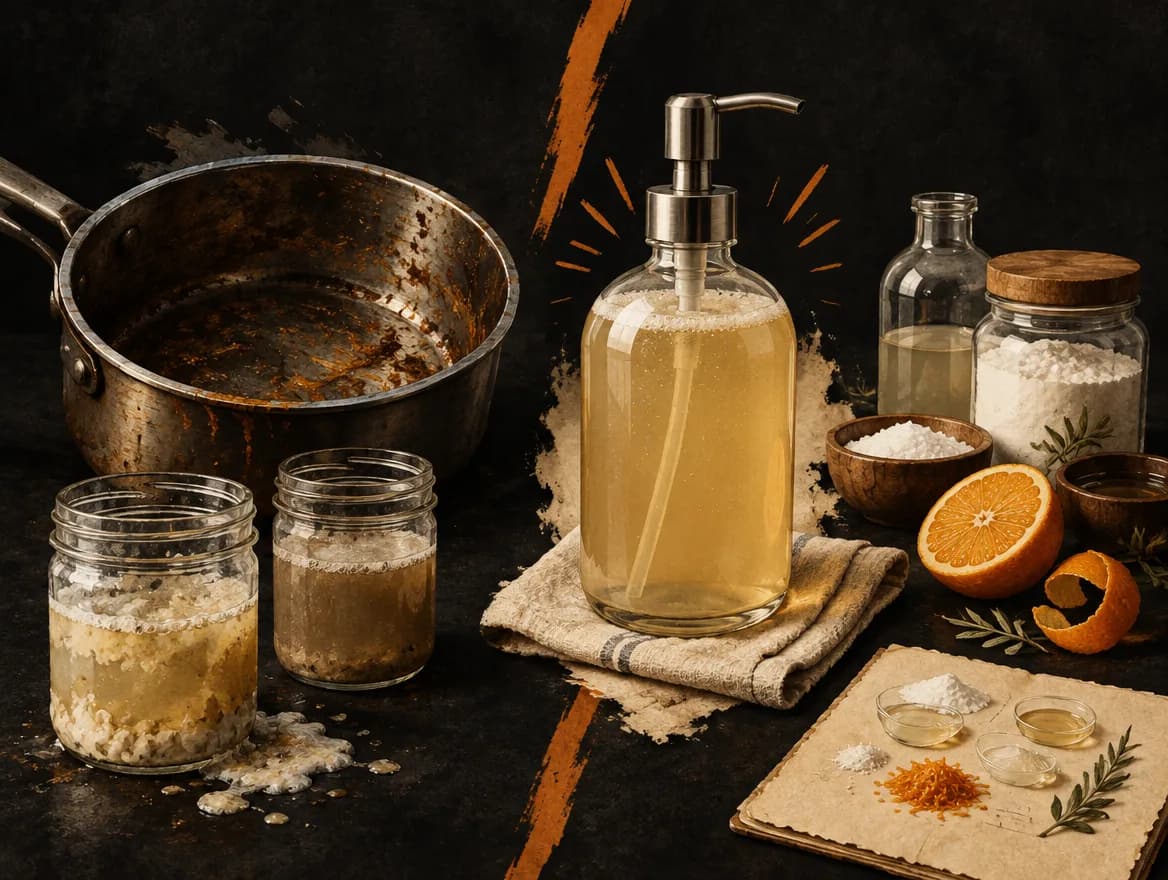
Family-tested result
One liquid dish soap batch was an exceptional degreaser: a completely grease-filled pot came clean in one wash. The known ingredient line included liquid Castile soap, fractionated coconut oil, and sunflower lecithin, but the exact ratios for that successful batch are unavailable.
Ingredients
Successful batch size unknown; older thick version was approximately 3/4 cup before minor additions. A later untested revision was labeled 64 oz but does not reliably total 64 oz.Check off each item as you go.
Method
Identify the intended version
Use the labeled early written starter as a reference, or the separately recorded later batch. Do not combine the quantities from both into a supposed family-tested recipe.
Work in a small, measured trial
Record every ingredient and keep the older acid-containing version as history, not a recommended current mixture. Do not use a large batch to discover whether the formula is compatible.
Recorded mixing sequence
Dissolve the selected amount of washing soda in the specified water, allow it to cool to warm, then stir the soap and glycerin in gently. The later lecithin/oil additions need their own measured trial because their successful ratios are not established.
Check the result before adopting it
Record separation, graininess, skin comfort, rinsing and grease removal after the batch rests. Stop using a mixture that irritates skin, leaves residue or damages a surface.
Safety & handling
- For hand dishwashing only. Do not put foaming Castile soap in an automatic dishwasher.
- Do not add acids to true soap to chase thickness or a lower pH. Preserve acid-containing old versions as historical experiments.
- Washing soda can irritate skin and eyes. Use appropriate handling precautions and gloves; avoid aluminum or surfaces whose manufacturer excludes alkaline cleaners.
Troubleshooting
- Greasy soap: reduce or omit fractionated coconut oil in the next isolated test; do not alter several variables at once.
- Tacky or slick with weak lather: suspect excess oil, excess glycerin, hard-water soap scum, or electrolyte-driven separation.
- Very thin soap: added water cannot thicken liquid Castile. Do not use salt as though this were a commercial detergent; true potassium soap may salt out and separate.
- Very thick or grainy soap: the older high-washing-soda formula may be a crystal slurry rather than a stable gel.
- Separation after adding acid: citric acid, lemon juice, or vinegar may be converting soap back into fatty acids.
- Poor performance in hard water: test with distilled water before changing the remaining ingredients.
- Darkening or pitting on cookware: stop use immediately; the alkaline formula can attack aluminum.
Insider tips
- Warm thick sunflower lecithin with glycerin before incorporation; lecithin does not stir readily into the water phase.
- Do not scale fractionated coconut oil linearly. A tripled batch became greasy because the added oil overwhelmed the cleaning system.
- Distilled water may improve performance where hard-water minerals suppress Castile lather and create soap scum.
- Castile soap is naturally fluid. Added water makes it thinner; apparent thickness can come from suspended washing-soda crystals rather than a stable soap gel.
- A warm-water test can help identify crystal thickening: a soda-heavy slurry may thin when warmed and thicken again when cool.
- Record future batches by weight so the successful version can be reproduced accurately.
Complete early written starter recipe
- 1/2 cup liquid Castile soap; 2 tablespoons washing soda; 1/4 cup hot water; 1 tablespoon vegetable glycerin; 10 drops lemon or orange essential oil.
- The written sequence dissolved washing soda in the hot water before combining it with the soap and glycerin. A later skin-dryness response proposed 2 tablespoons glycerin and less washing soda instead.
- This early written starter did not contain sunflower lecithin or fractionated coconut oil. It must not be labeled as the later exceptionally successful grease-cutting batch.
Why the later ratios remain separate
- The later thick batch recorded in the main ingredient list used 4 tablespoons washing soda and 1/2 teaspoon citric acid.
- The proposed 64-ounce reformulation and the greasy tripled batch are different events, not a verified scaling rule.
- The family success is real, but the available ordinary conversation text does not reliably assign every quantity to that successful batch.
Family notes
- One family-made batch removed all the grease from a heavily grease-filled pot in one wash.
- Another version became tacky, slick, and lower-lather over time.
- Tripling a version produced soap that was itself excessively greasy.
- A later batch was much too thin.
- An older Castile-based recipe became extremely thick.
- Heather specifically had difficulty incorporating thick sunflower lecithin.
- The versions must remain separate because the successful result cannot be confidently assigned to the later proposed ratios.
Background & original notes
Family-tested result
One liquid dish soap batch was an exceptional degreaser: a completely grease-filled pot came clean in one wash. The known ingredient line included liquid Castile soap, fractionated coconut oil, and sunflower lecithin, but the exact ratios for that successful batch are unavailable.
Partially recovered older thick version
The history preserves 1/2 cup liquid Castile soap, 1/4 cup hot water, 4 tablespoons washing soda, and 1/2 teaspoon citric acid. Glycerin and sunflower lecithin were also present, but their quantities—and whether fractionated coconut oil belonged to this exact version—were not preserved. This batch became very thick, probably because the washing soda exceeded what the small amount of water could keep dissolved and also salted the potassium soap out of solution. Its thickness should not be interpreted as proof of a stable gel.
LATER 64-OUNCE REVISION — CLAUDE PROPOSAL, NOT FAMILY-TESTED A later proposed revision used 3 cups Castile soap, 1/2 cup washing soda, 2 1/2 cups distilled water, 1/4 cup glycerin, 1 tablespoon fractionated coconut oil, 1 teaspoon citric acid, 2 tablespoons sunflower lecithin, and about 1 teaspoon lemon essential oil. This was intended to prevent the greasiness encountered when every ingredient—especially the oil—was tripled. However, the listed ingredients do not reliably total 64 fluid ounces, and no successful family outcome was recorded for this revision.
USE Because the successful formula is incomplete, begin with a small amount on a wet sponge or in a sink of water and adjust by observed cleaning performance. Do not present either recovered version as a finalized, family-validated formula.
Safety
The older thick version contains a very high concentration of washing soda and was estimated to be strongly alkaline. Wear gloves, keep it away from children, and do not use it on aluminum, anodized aluminum, or uncertain sheet pans. Do not mix liquid Castile soap directly with vinegar, lemon juice, or extra citric acid; acids can break true soap into free fatty acids and reduce cleaning performance.
Sources & what was completed
Record provenanceReviewed against original conversation text and attachments on September 27, 2026. Recorded family outcomes, original assistant proposals, and current editorial completion are distinguished below.
Completed for usability- The operational mixing order, small-batch recovery procedure, cautious use guidance, and troubleshooting were completed from Claude's technical advice.
- The successful batch's exact ingredient quantities, batch size, and method remain unrecovered.
- The partially recovered thick formula must not be presented as the proven grease-cutting batch.
- The later formula labeled as 64 ounces was an assistant proposal, was not recorded as family-tested, and appears not to total exactly 64 fluid ounces.
- No untested revision is claimed to work.
- A complete early written starter formula has now been recovered and displayed separately; it is not substituted for the later successful batch.
Recorded by Reviewed source recovery on Sep 27, 2026.