
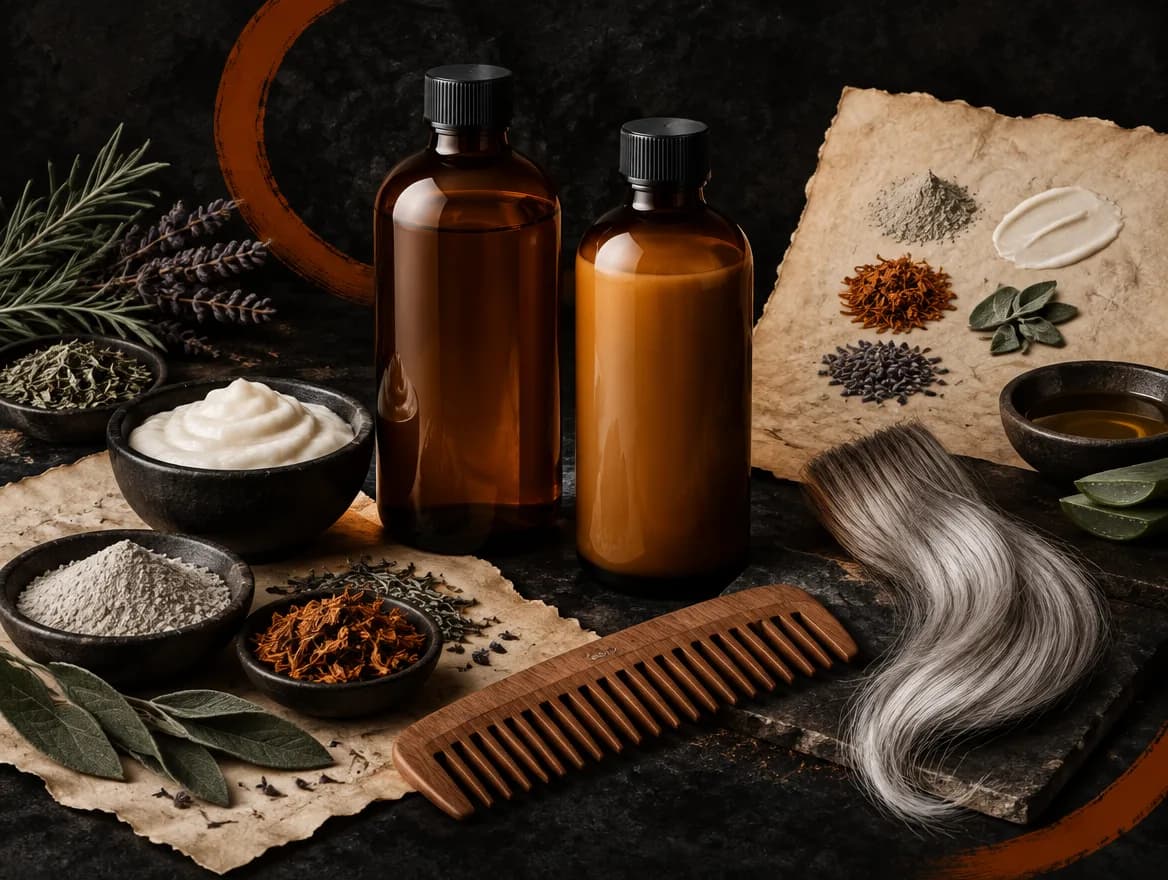
This is a proposed formulation, not a family-tested recipe. Make small pilot batches and weigh ingredients in grams. Target pH is 4.5–5.5 for shampoo and 4.5–5.0 for conditioner. Use: massage a small amount of shampoo into the wet scalp, work the lather through the hair, and rinse thoroughly. Apply conditioner mainly to lengths and ends, leave briefly, then rinse. The optional weekly rinse is poured through clean hair as the final rinse, but essential oil should be omitted unless properly solubilized. Because these products contain water and an herb-rich decoction, their preservation and shelf life must be verified rather than assumed.
Ingredients
Proposed system: approximately 480 g shampoo, approximately 240 g conditioner, plus optional 16 fl oz weekly rinseCheck off each item as you go.
Method
Sanitize and prepare
Clean and sanitize the work area, utensils, heat-safe vessels, blender, and containers. Use a gram scale, thermometer, and calibrated pH meter or suitable narrow-range strips. Wear a particulate mask while handling dry SCI.
Make the shared decoction
Combine the distilled water, nettle, horsetail, rosemary, chamomile, blue malva or cornflower, and calendula. Bring to a gentle simmer, cover, and simmer for 25 minutes. Cool covered, strain very thoroughly through fine cloth, and weigh the portions needed for the formulas.
Begin the shampoo
Warm 340 g decoction in a double boiler to about 170°F. Sprinkle in the SCI and stir gently until dispersed and as smooth as the selected SCI form allows, avoiding vigorous agitation and foam.
Finish the shampoo base
Remove from heat and gently stir in cocamidopropyl betaine and glycerin. Cool below the temperature limit specified for the preservative. Premix xanthan gum with a little glycerin if needed to reduce clumping, then incorporate it.
Adjust and preserve the shampoo
Measure pH and adjust gradually with a prepared dilute citric acid solution to 4.5–5.5. Add preservative according to its current supplier instructions. Add optional essential oils only if their concentration and dispersion are appropriate. Recheck pH, bottle, label, and record the batch.
Make the infused jojoba
Cover equal parts dried nettle and horsetail completely with jojoba oil. Infuse for 4–6 weeks in a cool, dark place and strain, or use the source's proposed warm method of approximately 110°F for 2 hours before straining. Keep water out of the oil infusion.
Heat the conditioner phases
In one heat-safe vessel combine 175 g decoction and honey. In another combine BTMS-50, cetyl alcohol, infused jojoba, argan oil, and camellia oil. Heat both phases in a water bath to 160–170°F until the oil phase is completely melted.
Emulsify the conditioner
Slowly combine the oil phase with the water phase while blending. Blend in short bursts for about 2 minutes, then stir gently as the emulsion cools.
Complete the conditioner
Below the temperature limits specified for the cool-down ingredients, mix in hydrolyzed oat protein and the selected preservative. Add optional essential oils only at a verified safe concentration. Adjust measured pH gradually to 4.5–5.0, recheck after the emulsion has settled, package, label, and record the batch.
Use the shampoo and conditioner
Patch test first. On wet hair, use a small amount of shampoo on the scalp and rinse well. Apply conditioner mainly to lengths and ends, leave for 1–5 minutes, and rinse. Begin conservatively and adjust quantity and frequency according to scalp comfort, buildup, and hair response.
Prepare the optional weekly rinse
Combine 1.5 cups cooled decoction with 2 tablespoons apple cider vinegar. Omit the originally proposed rosemary essential oil unless a suitable solubilizer and verified safe concentration are used. Apply after washing as a final rinse only if the scalp tolerates it. Refrigerate promptly and discard at the first sign of odor, gas, clouding, or other spoilage.
Troubleshooting
- If shampoo is too thin, first allow it to rest; then refine the thickening system in a later pilot rather than adding unmeasured gum directly to the finished batch.
- If xanthan clumps, premix it with glycerin before adding it slowly.
- If shampoo produces excessive foam during manufacture, reduce agitation and allow bubbles to settle before packaging.
- If the conditioner separates, verify that both phases reached a compatible temperature, the BTMS-50 fully melted, weights were accurate, and sufficient mixing occurred.
- If hair feels coated or limp, reduce conditioner quantity, concentrate it on the ends, or lower the oil load in the next revision.
- If hair or scalp feels dry, itchy, or irritated, stop use and reassess surfactant strength, fragrance ingredients, pH, and individual sensitivities.
- If the rinse stings, discontinue it or reduce the vinegar concentration; never use it on broken or irritated skin.
- Discard any product showing mold, gas, swelling, separation accompanied by odor, unexpected color change, or other spoilage.
Insider tips
- Start with a small shampoo pilot before attempting the conditioner emulsion.
- Use distilled water and weigh ingredients rather than relying on volume measurements.
- Measure pH after full mixing and again after the product has rested; pH strips give only an approximation.
- Keep shampoo agitation gentle to avoid excessive foam during manufacture.
- The conditioner will normally thicken further as it cools and rests.
- A chelating ingredient or an appropriately selected commercial chelating treatment may be more predictable than botanicals when mineral buildup is contributing to dull or yellow-looking silver hair.
- The source shopping list included SCI, cocamidopropyl betaine, BTMS-50, cetyl alcohol, preservative, hydrolyzed oat protein, xanthan gum, dried herbs, jojoba, argan and camellia oils, glycerin, essential oils, distilled water, a gram scale, pH testing supplies, heat-safe vessels, blender, and suitable bottles or jars.
Family notes
- Heather requested a best-quality shampoo and conditioner specifically for coarse silver or grey hair, aiming for a clean scalp, soft hair, and a non-drying result.
- Heather intended to make the products eventually and requested both recipes and a shopping list.
- The record was explicitly described as planned and not tested.
- A later family discussion noted that herbs can soften, add slip, and improve manageability, but cannot chemically relax hair.
- The original proposal suggested blue malva or cornflower for subtle brightening and asked whether Heather preferred botanical brightening or a visibly depositing purple pigment; no preference was recorded.
Sources & what was completed
Record provenanceWilliams family historical source + clearly separated usability completion
Completed for usability- The original shampoo quantities total slightly more than the stated 480 g before pH adjustment and essential oils; the conditioner quantities total less than the stated 240 g. They are preserved here as proposed source amounts and require recalculation before a controlled production batch.
- Use instructions, sanitation, patch testing, measured pH adjustment, batch labeling, and spoilage guidance were added to make the record operational.
- The source claimed approximately three months of room-temperature shelf life, but that claim is not retained as established. An herb-rich water formula needs a preservative selected for the complete formula and verification through stability and microbial challenge testing.
- Preservative choice and percentage must follow current supplier documentation. Leucidal Liquid SF at the proposed rate should not be assumed to provide adequate broad-spectrum preservation without testing.
- The original rinse included free-floating rosemary essential oil. The operational completion omits it unless properly solubilized because essential oil does not disperse safely in a water-and-vinegar rinse by simple stirring.
- Botanical toning and claimed strengthening effects remain proposed rather than demonstrated outcomes.
- No sales, gifting, or extended storage should be based on this draft without professional formulation review, compliant manufacturing practices, and preservation testing.
Recorded by Williams family record + completion on Sep 26, 2026.