
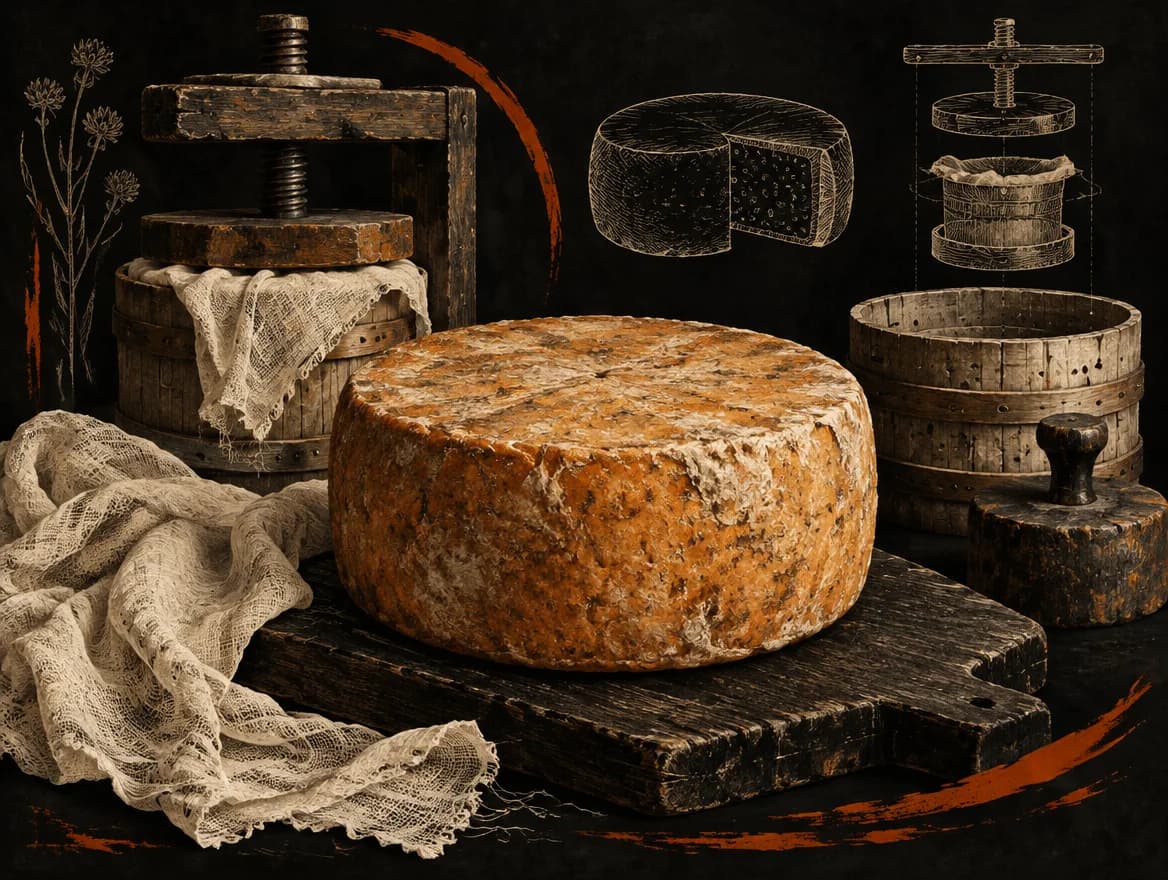
This record preserves Heather’s first farmhouse cheddar as a historical batch rather than a finalized formula. The family source documents approximately 2.5 gallons of local milk, mesophilic culture, and young clabber. The milk produced a slow curd set, but Heather continued successfully through cutting, cheddaring, salting, and pressing. The cheese was pressed for about 20 hours at 25 pounds.
Ingredients & materials
Check off each item as you go.
Recorded process
Warm and culture the milk
Warm the milk to the temperature required by the selected farmhouse-cheddar method. Add the mesophilic culture and young clabber, mix gently, and allow the milk to ripen. The original temperatures, quantities, and ripening time were not recorded.
Coagulate
Add properly measured rennet according to its product strength and the milk volume, then leave the milk undisturbed. This batch set slowly; proceed according to curd firmness and a clean break rather than relying only on elapsed time.
Cut and cook the curd
Cut the set curd into even pieces, rest briefly, and stir while gradually warming according to the cheddar method being followed. Continue until the curds are firm enough to drain without excessive shattering.
Drain and cheddar
Drain the whey, gather the curd into slabs, and keep the slabs warm. Turn and stack them periodically until they become cohesive and develop the characteristic layered, resilient texture of cheddared curd.
Mill and salt
Cut or tear the cheddared slabs into small pieces. Add the measured cheese salt in several additions, mixing evenly. The original salt quantity was not recorded.
Mold and press
Pack the salted curds into a lined mold and press, turning and redressing as needed. Heather reported a final press of about 20 hours at 25 pounds.
Dry and age
Remove the wheel from the press and air-dry it on a clean surface, turning regularly, until the exterior is dry. Apply the intended rind treatment and age under controlled conditions appropriate for cheddar. The aging duration and final result for this batch were not recorded.
Safety & handling
- Use clean, food-safe equipment and milk from a source appropriate for cheesemaking.
- Do not infer safety from appearance, smell, beeswax, raw-milk cultures, or aging time alone.
- Maintain controlled aging temperature and humidity, inspect the cheese regularly, and seek qualified guidance if mold penetrates cracks or the paste develops unexpected discoloration, swelling, slime, or objectionable odor.
- Beeswax can protect a dry, sound surface but should not be treated as a guarantee against contamination trapped beneath it.
Insider tips
- A slow set is not automatically a failed set; judge the curd by firmness and clean-break behavior before cutting.
- Record the brand and strength of rennet because tablet and liquid products can differ substantially in dose.
- Use curd texture as well as time when cheddaring: the slabs should become cohesive, layered, and resilient.
- Small or partially cut wheels lose moisture more quickly than full wheels and require closer rind and humidity monitoring.
- If a crack develops during aging, inspect it rather than simply sealing over questionable material. Heather later used salt brine, thorough drying, and beeswax when managing vulnerable cheese surfaces.
Family notes
- Heather chose a combination of mesophilic culture and young clabber.
- The curd set was slow, but the batch proceeded through the full make successfully.
- The curds were cut, cheddared, salted, and pressed.
- The reported pressing stage was about 20 hours at 25 pounds.
- No final aging or standalone tasting result was preserved for this batch.
Background & original notes
This record preserves Heather’s first farmhouse cheddar as a historical batch rather than a finalized formula. The family source documents approximately 2.5 gallons of local milk, mesophilic culture, and young clabber. The milk produced a slow curd set, but Heather continued successfully through cutting, cheddaring, salting, and pressing. The cheese was pressed for about 20 hours at 25 pounds.
The detailed culture, rennet, and salt quantities were not retained, so this should not be treated as a repeat-ready canonical recipe. The steps below complete only the ordinary workflow needed to make the record understandable and usable as a starting point. Future batches should record exact culture, clabber, rennet, salt, temperature, acidity or timing, curd texture, wheel weight, and aging results.
After pressing, the cheese may be air-dried until the surface is dry and then aged using the chosen rind treatment. During later aging work, Heather used beeswax to protect vulnerable cut or cracked areas and managed surface mold with salt brine. Those aging practices belong to her broader cheesemaking experience, but the final aging and flavor outcome of this particular first cheddar was not documented.
Sources & what was completed
Record provenanceWilliams family historical source + clearly separated usability completion
Completed for usability- The warming, ripening, renneting, curd-cooking, drying, and aging directions are ordinary cheddar-process completions added for usability; they are not documented as Heather’s exact actions.
- Rennet and salt are included as process-required ingredients, but their original types and amounts were not retained.
- No invented aging duration, yield, or tasting result has been assigned to the family batch.
Recorded by Williams family record + completion on Sep 26, 2026.