
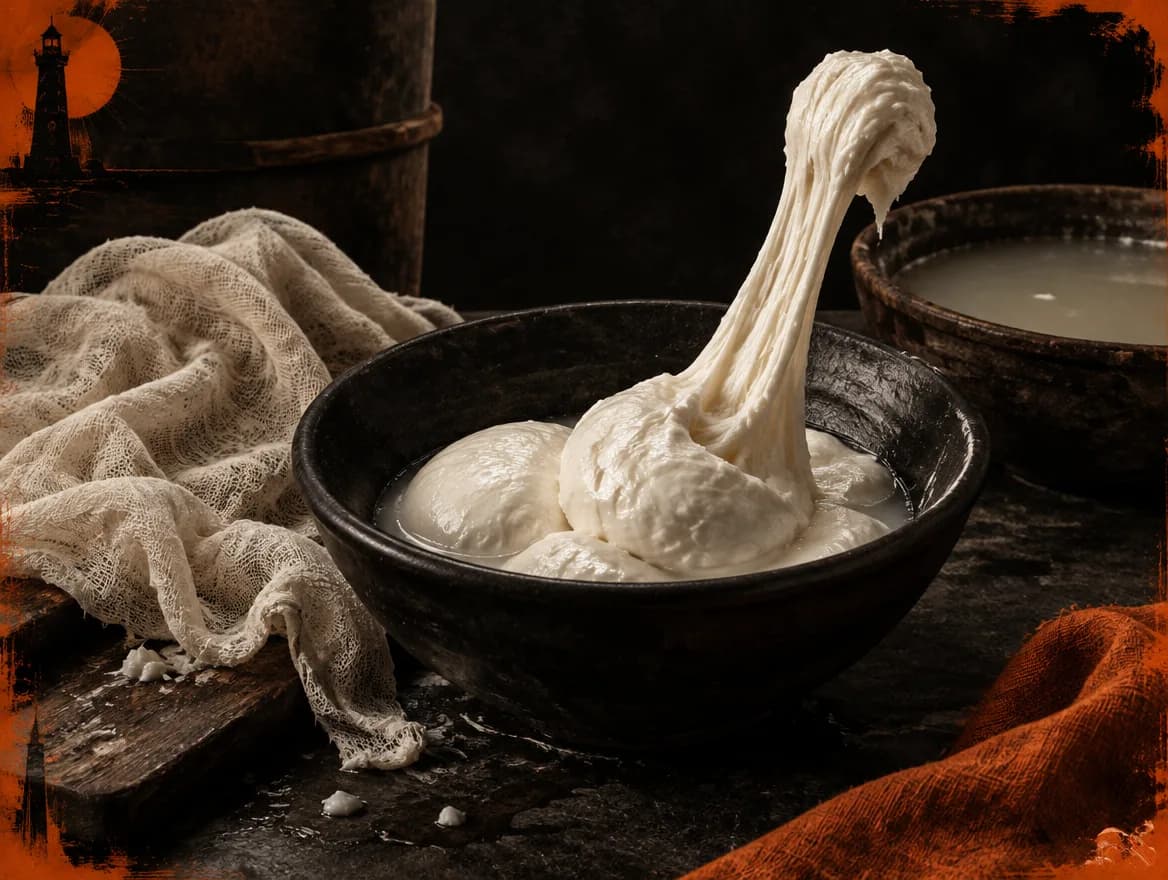
Warm-cultured mozzarella made by ripening milk with thermophilic culture, setting it with rennet, draining and acidifying the curd, then stretching only when a test piece becomes smooth and glossy. Follow the curd’s clean break and stretch behavior rather than relying on fixed times.
Ingredients
About 1.5–2 pounds, depending on the milk and moisture retainedCheck off each item as you go.
Method
Warm the milk
Slowly warm the milk to 95°F, stirring gently to prevent scorching.
Ripen with culture
Add the thermophilic culture according to its directions and mix gently. Cover and hold near 95°F for about 45 minutes.
Add the rennet
Fully dissolve the rennet tablet in cool, non-chlorinated water. Stir it into the milk with a gentle up-and-down motion for about 30 seconds, then stop all movement, cover, and hold near 90–95°F.
Wait for a clean break
Begin checking after about 45 minutes, but allow additional undisturbed time if necessary. The curd is ready when a knife or finger lifts a clean split and clear-to-yellowish whey enters the opening. Do not add more rennet merely because the set is slow.
Cut and heal the curd
Cut the curd into roughly 1-inch cubes. Let the pieces rest undisturbed for 5–10 minutes so their surfaces can firm.
Cook the curds
Over about 30 minutes, gently raise the curds to approximately 105°F while stirring carefully enough to keep them separated. Hold until they feel springier and release more whey.
Drain
Transfer the curds to a colander or draining cloth and allow the whey to drain. Keep the curd mass comfortably warm so the culture can continue acidifying it.
Acidify and test
Let the drained curd rest warm, testing periodically rather than following the clock alone. Place a small piece in 170–175°F water for about a minute, then try to pull it. If it crumbles or tears instead of forming a smooth, glossy rope, return the main curd to its warm rest and test again later.
Stretch
When the test piece stretches smoothly, cut the curd into manageable pieces and warm them in the hot water until pliable. Using heat-resistant gloves and a utensil as needed, fold and stretch gently just until the cheese becomes glossy and cohesive. Avoid excessive working, which can make it tough and dry.
Shape and salt
Fold the cheese into balls or a loaf, working salt into the final folds or salting the surface to taste. Cool promptly and refrigerate.
Safety & handling
- Raw milk can carry harmful microorganisms; fermentation and cheesemaking do not guarantee that it is safe. Use milk from a trusted, properly handled source and follow applicable public-health guidance, especially for children, pregnant people, older adults and immunocompromised people.
- Keep equipment and hands thoroughly clean, and discard the batch if it develops abnormal colors, visible mold, a putrid odor or other signs of contamination.
- Stretching water near 175°F can cause serious burns. An adult should control this stage and use heat-resistant gloves and suitable utensils.
- Refrigerate the finished fresh mozzarella promptly and use it while fresh; this is not a shelf-stable product.
Insider tips
- The recorded milk temperatures of roughly 93–97°F during renneting were within a workable range and were unlikely to explain the slow set.
- Trust a clean break rather than the clock. Raw milk, culture activity, rennet strength and handling can all change the setting time.
- After adding rennet, keep the pot still; repeated checking can damage a curd that is beginning to form.
- A crumbly stretch-test piece usually indicates that the curd needs more warm acidification time, not more rennet.
- The child-friendly stages include stirring, observing the clean break and gently handling cooled curds. The hot-water stretch requires close adult control.
- If the curd never becomes stretchable, it may still be drained, salted and used as a fresh crumbly cheese, but this fallback was not recorded as the family’s outcome.
Family notes
- Heather chose the half-day thermophilic method because she wanted the stretching experience with her daughter.
- The family batch used two gallons of milk, thermophilic culture and one rennet tablet.
- The milk was heated to 95°F, cultured for 45 minutes and then renneted.
- During the recorded attempt, the curd had not set after the initial 45 minutes plus another 10 minutes.
- The temperature was about 97°F when the rennet was added and later measured 93°F.
- No final cheese result was recorded.
Sources & what was completed
Record provenanceWilliams family historical source + clearly separated usability completion
Completed for usability- The source did not preserve the original displayed recipe or a finished outcome.
- Ingredient quantities not stated by Heather, curd cutting, cooking, draining, acidification, stretching, salting and storage directions were completed from standard cultured-mozzarella practice for usability.
- The added directions are editorial completion and must not be interpreted as a family-tested formula or successful Williams-family result.
- Because rennet tablets and starter cultures vary in strength, their manufacturer’s directions take precedence over the generalized completion.
Recorded by Williams family record + completion on Sep 26, 2026.