
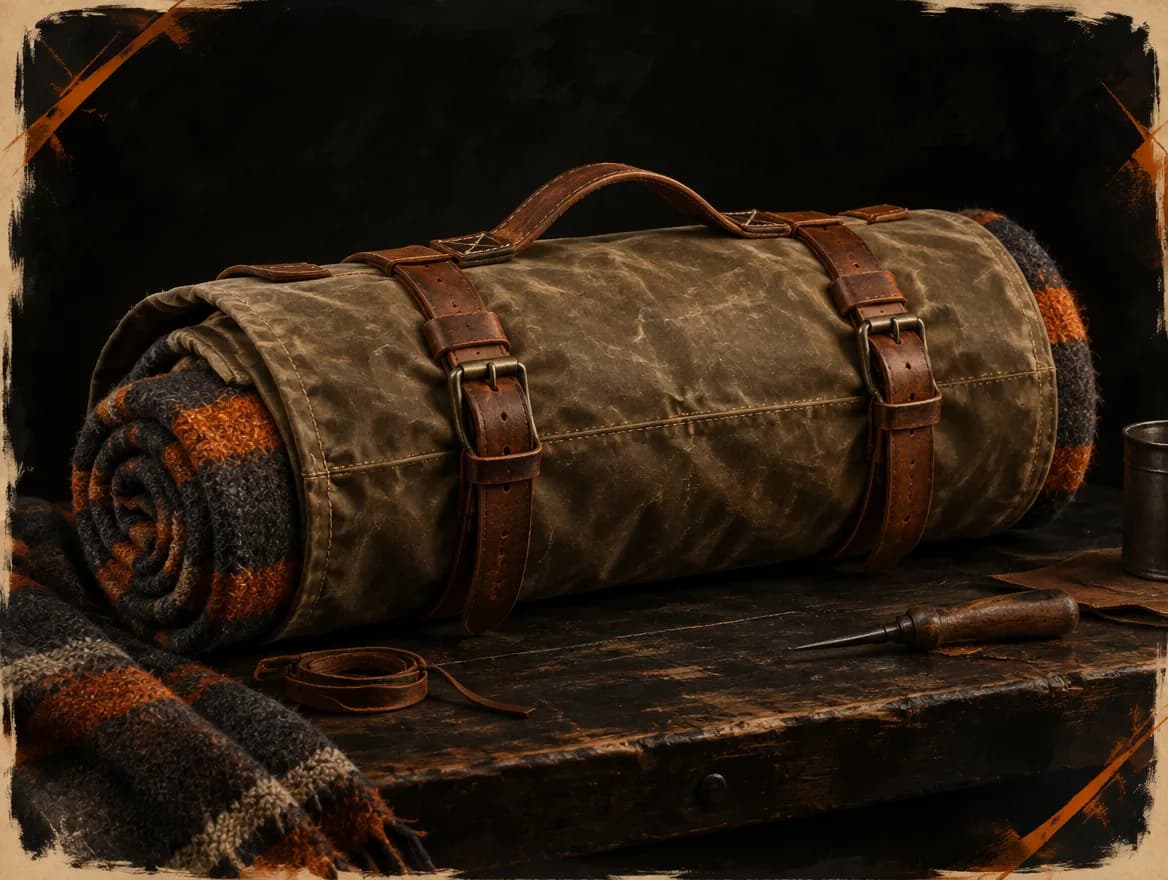
## Family build
Materials
Four planned 9 × 12 ft bedrolls; two reported complete as of 2026-04-29Check off each item as you go.
The project, step by step
Confirm the layout
Lay the canvas exterior-side down, center the wool blanket, and test the fit around a person before making permanent changes.
Form the foot pocket
Fold the foot end upward first so the finished enclosure has a protected toe end.
Fold the sides
Bring the long sides toward the center; Heather considered an overlap of about 6 inches.
Choose and test the closure
Try fold-only packing or prototype reinforced grommets and ties on scrap. Do not cut the finished canvas until the preferred arrangement and spacing are confirmed.
Reinforce optional grommets
If using grommets, place each through a doubled-canvas or leather reinforcement patch and test it under moderate hand tension.
Apply the coating
Remove the wool, wax the outward-facing canvas in small sections, and use controlled warmth to work the coating into the weave without scorching it.
Cool and cure
Let the coated canvas cool and rest before folding it tightly or returning the wool insert.
Assemble and roll
Replace the blanket, restore the foot and side folds, roll firmly, and secure the bundle evenly with leather belts.
Compare performance
Test water beading, debris pickup, tackiness, coating transfer, closure strain, condensation, and field comfort before standardizing all four rolls.
Troubleshooting
- If a grommet distorts or the surrounding weave stretches during the scrap test, increase the reinforcement area or use sewn ties instead.
- If the coating remains tacky and collects debris, allow more curing time and compare it with the homemade finish before adding more wax.
- If wax sits visibly on the surface, warm the area gently and redistribute it rather than adding another heavy layer.
- If the blanket shifts during rolling, refine the fold dimensions or add removable internal ties only after testing their effect on comfort.
- If washed wool shrinks, stiffens, or felts, stop further agitation and revise the washing process before treating the remaining blankets.
- If water fails to bead during the drop test, note whether coverage was thin or uneven; do not claim waterproofing until field-tested.
Insider tips
- Install hardware before waxing so tools and reinforcement patches can grip clean fabric.
- Keep the wool removable while the design and washing method are still being evaluated.
- Use the old grommet setter on scrap first; age alone does not make a simple setter unusable if its working faces remain sound.
- A fold-only closure avoids holes in the canvas, while reinforced grommets provide adjustable retention; the better choice depends on field testing.
- Wax only the face intended to meet weather and ground unless later testing demonstrates a need for additional coverage.
- An 80% wool/20% nylon blanket was considered preferable to an 80% wool/20% acrylic blend for this use, but the actual purchased blankets were described as 95% wool.
Family notes
- Heather planned four bedrolls and reported that two were finished by April 29, 2026.
- The family selected 12 oz, 9 × 12 ft cotton canvas and 95% wool blankets.
- Heather found $4 thrift-store leather belts for the rolls.
- The family already owned an older grommet kit but questioned whether grommets might compromise the canvas.
- A center overlap of approximately 6 inches was being considered.
- One Otter Wax-coated roll consumed two bars costing $19 each.
- Heather observed that Otter Wax felt tacky or sticky and held more debris.
- Heather observed that the fresh homemade pine-resin finish felt less tacky and cleaner.
- A drop-of-water test had not yet been performed.
- Four finished rolls and a standardized final closure were not established in the family record.
Background & original notes
## Family build
The planned build uses 12 oz, 9 × 12 ft natural cotton canvas, waxed on the exterior, with 95% wool blankets as removable fill. Heather found $4 thrift-store leather belts for securing the rolled beds. Four bedrolls were planned; two were reported finished on April 29, 2026.
## Layout
Lay the canvas out with its eventual exterior face downward. Center the wool blanket, leaving canvas around it for the foot pocket and side folds. Fold the foot end upward first, then bring the long sides toward the center. Heather considered approximately 6 inches of overlap where the sides meet. Confirm the folds around a person and blanket before waxing or installing hardware.
## Closure decision
A final family-tested closure was not established. Options discussed were a fold-only enclosure or reinforced grommets with removable ties. The family raised a valid concern that grommets could weaken the canvas. If grommets are used, trial the old setting kit on scrap material and reinforce every hole with doubled canvas or leather so pulling force is spread beyond the cut edge. Ball-bungee ties were considered for convenience, despite their plastic construction. Leather lacing, cord, or sewn canvas ties are natural-material alternatives, but none was reported as the final choice.
## Waxing
Wax the outward-facing canvas surface rather than the wool. Apply the wax bar in small sections and use controlled warmth to help it enter the weave. Avoid overheating the cotton, wax, or resin. Give seams and exposed edges careful coverage, then allow the canvas to cool and cure before inserting the blanket or rolling it tightly.
Heather compared two completed rolls: one used two $19 Otter Wax bars and felt tacky or sticky, collecting more debris; the fresh homemade pine-resin wax finish felt less tacky and cleaner. Neither finish had yet received the planned drop-of-water test, so waterproofing performance was not established.
## Wool insert
The family bought 95% wool blankets. If washing before assembly, follow the blanket label and minimize heat, agitation, wringing, and abrupt temperature changes to reduce felting. Air-drying flat or well supported is the conservative choice. Keep the blanket removable until washing behavior, fit, and field comfort are known.
## Packing
With the blanket inside, restore the foot and side folds, then roll the bedroll firmly. Secure it with two or more leather belts positioned to keep the bundle even. Reused belts should be checked for cracking, weak buckle stitching, and hardware that could abrade the waxed canvas.
## Validation still needed
Perform a controlled water-drop comparison on offcuts or inconspicuous areas, then test each completed roll outdoors for debris pickup, coating transfer, cold-weather flexibility, condensation, closure strain, blanket shifting, and ease of repacking. Record results before standardizing the remaining builds.
Sources & what was completed
Record provenanceWilliams family historical source + clearly separated usability completion
Completed for usability- The ordered build method, reinforcement guidance, validation checklist, and closure comparison complete the project instructions for usability; they were not reported as family-tested.
- Quantities for the homemade beeswax–pine-resin bars were not supplied and have not been invented.
- The 6-inch overlap and optional reinforced-grommet method remain prototypes until the family tests and adopts them.
- No claim is made that either coating waterproofed the canvas successfully.
Recorded by Williams family record + completion on Sep 26, 2026.