
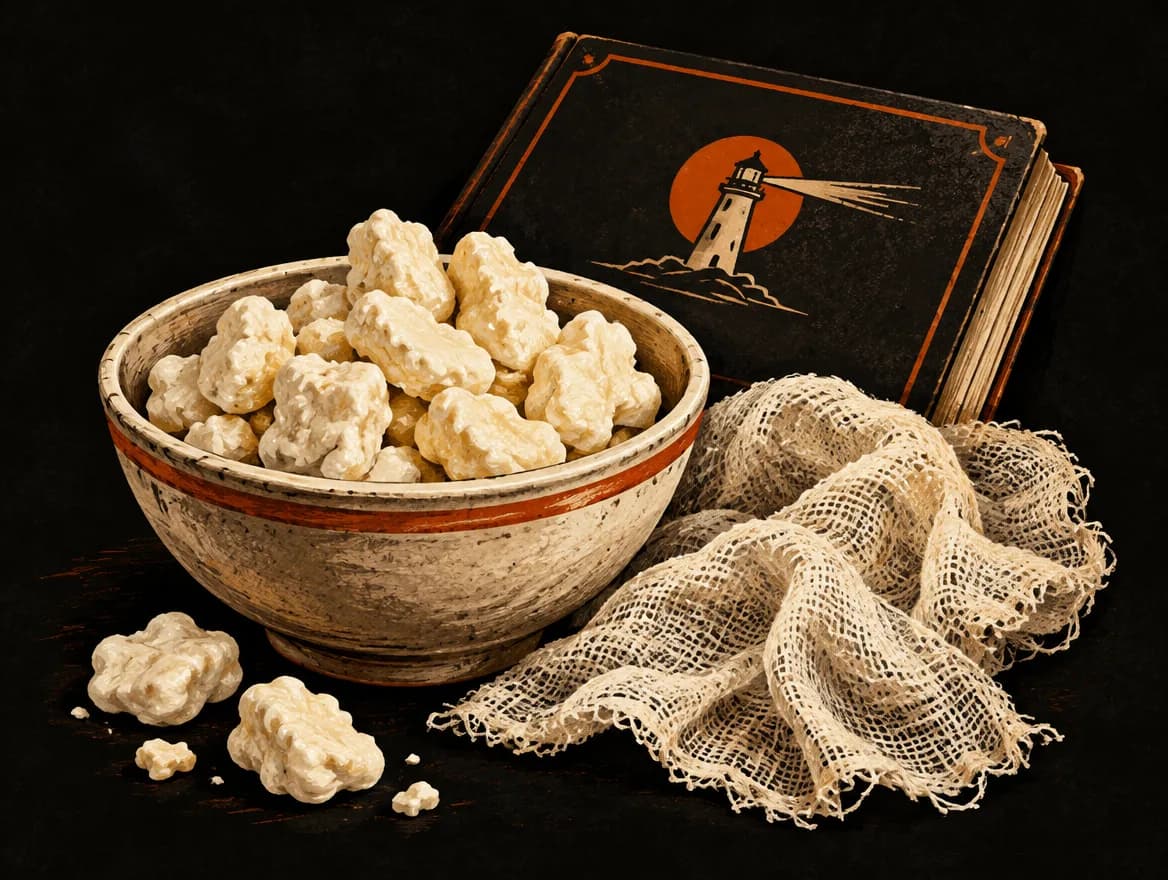
This usable formula completes the missing family recipe using a standard cheddar-curd process. The quantities, temperatures and steps are a reconstruction and must not be interpreted as a family-tested formula. Heather’s established preferences—fresh milk, freezer-stored mesophilic culture and an optional contribution from mature clabber—are retained. For the most predictable first repeat, use the commercial mesophilic culture as the primary starter. Keep the curds cold after making them and plan to enjoy them while fresh.
Ingredients
Approximately 1½–2 pounds fresh curdsCheck off each item as you go.
Method
Sanitize and warm the milk
Clean and sanitize the pot, utensils, colander, cloth and work surfaces. Warm the milk slowly to 88–90°F (31–32°C).
Add the starter
Add the mesophilic culture according to its package directions and mix thoroughly. If using clabber under a trusted method, add the planned small quantity now. Hold at 88–90°F for about 30–45 minutes.
Set the curd
Stir in the diluted calcium chloride, if using. Add the diluted rennet and stir gently for about one minute. Cover and hold the milk still at 88–90°F until a clean break forms, usually 30–45 minutes.
Cut and heal
Cut the curd into roughly 1/2-inch cubes. Let the cubes rest undisturbed for 5 minutes so their cut surfaces firm.
Cook the curds
Over approximately 30 minutes, slowly raise the temperature to 100–102°F (38–39°C), stirring gently to prevent matting. Hold there for another 30 minutes, stirring occasionally, until the curds feel springy and hold their shape.
Drain and cheddar
Drain off the whey and keep the curd mass near 95–100°F. Form it into slabs. Stack and turn the slabs every 15 minutes for 60–90 minutes, switching their positions each time, until they become cohesive and tear into fibrous layers.
Mill and salt
Cut or tear the slabs into bite-size pieces. Weigh the curds and calculate salt at about 2% of their weight. Add the salt in two or three portions, tossing between additions while the curds remain warm.
Cool and store
Spread the curds briefly so surface moisture can evaporate, then transfer them to a clean covered container and refrigerate promptly at 40°F (4°C) or colder. For their best flavor and squeak, serve the same day and use within 3–4 days.
Safety & handling
- Raw milk can contain harmful microorganisms even when it looks and smells normal; children, pregnant people, older adults and immunocompromised people face greater risk. Pasteurized milk is the safer default for fresh curds.
- A pleasant-smelling or well-set clabber does not by itself establish microbiological safety. Use clabber only with a validated method, healthy milk handling and reliable acidification monitoring.
- Keep finished curds at 40°F (4°C) or colder and do not leave them at room temperature for more than two hours.
- Bitterness alone cannot establish whether curds are safe. Discard curds with mold, slime, gas production, swelling, putrid or yeasty odors, unusual discoloration, or questionable temperature history; do not rely on cooking to rescue suspect curds.
- Do not reduce rennet solely on the assumption that it caused bitterness. Measure accurately and evaluate the full process, including culture, acidity, salt, sanitation and storage.
Insider tips
- Use the freshest milk available for curds because they are eaten young rather than aged.
- Salt while the curds are still warm, adding it gradually and tasting as you go.
- A properly cheddared slab becomes cohesive and shows layered, chicken-breast-like fibers when torn.
- The squeak is strongest when the curds are fresh and served near room temperature; its loss during refrigeration is normal.
- Record the milk source, starter and rennet amounts, temperatures, timings, salt weight and refrigerated flavor changes so the next family batch can become a genuinely tested revision.
- Glass storage was not identified as the cause of the bitter batch. Review rennet dose, culture activity, salt level, sanitation, refrigerator temperature and storage time together.
Family notes
- Leo especially enjoyed the fresh curds, which motivated Heather to make another batch for him.
- Heather planned to make curds alongside a full Gouda wheel and considered allocating about two gallons of milk to the curds.
- Heather prefers very fresh milk and keeps mesophilic and thermophilic cultures in the freezer.
- Heather was developing a five-day clabber and wanted to use a little of it alongside commercial mesophilic culture until she felt confident in it.
- A later batch stored in glass in the refrigerator developed a bitter finish after about one week.
Sources & what was completed
Record provenanceWilliams family historical source + clearly separated usability completion
Completed for usability- The family source did not preserve the original ingredient quantities or procedure.
- The two-gallon yield, ingredient amounts, temperatures and cheddar-style method were supplied as an ordinary recipe completion for usability and have not been represented as family-tested history.
- The documented family outcomes—Leo enjoying fresh curds and a later refrigerated batch becoming bitter—were preserved separately from the reconstructed formula.
- Earlier source commentary confidently attributed the bitterness to proteolysis and suggested heat as a remedy; this record uses more cautious troubleshooting because bitterness has multiple possible causes and cooking does not make improperly stored dairy safe.
Recorded by Williams family record + completion on Sep 26, 2026.